
Mia (Marketing Intelligence Agent) Review 2026
Mia by Lifesight is an AI marketing intelligence agent for ecommerce teams. We tested its causal measurement, budget optimization, and forecasting features.


How this article was made
Atlas researched and drafted this article using AI-assisted tools. Todd Stearn reviewed, tested, and edited for accuracy. We believe AI assistance improves thoroughness and consistency — and we're transparent about it. Learn more about our methodology.
Try Mia (Marketing Intelligence Agent) today
Get started with Mia (Marketing Intelligence Agent) — free tier available on most plans.
Mia by Lifesight is a solid AI marketing intelligence agent for ecommerce teams that need causal measurement without hiring a data scientist. It automates budget scenario planning and cross-channel analysis. We tested Mia over 3 weeks using a demo environment with 4-channel ecommerce data (Meta, Google, TikTok, email). Best for mid-market brands spending $50K+ per month on ads. Pricing is custom and requires a demo request.

Quick Assessment
| Rating | 7/10 |
| Price | Custom pricing (demo required) |
| Best for | Ecommerce/retail teams spending $50K+/month on marketing |
Pros:
- Causal measurement goes beyond last-click attribution
- Scenario-based budget optimization saves hours of spreadsheet work
- Clean integrations with major ad platforms and Shopify
Cons:
- No transparent pricing makes evaluation difficult
- Steep learning curve for teams without analytics experience
Try Mia Free →
If you're already evaluating AI agent ROI for your marketing stack, Mia is one of the agents that directly ties to measurable spend decisions. It sits in a growing category alongside tools we've covered in our guide to AI agents for ecommerce.
What Is Mia (Marketing Intelligence Agent)?
Mia is an agentic AI built on top of Lifesight's Unified Measurement OS that does the analytical work your marketing team currently handles with spreadsheets, gut instinct, and too many dashboard tabs.
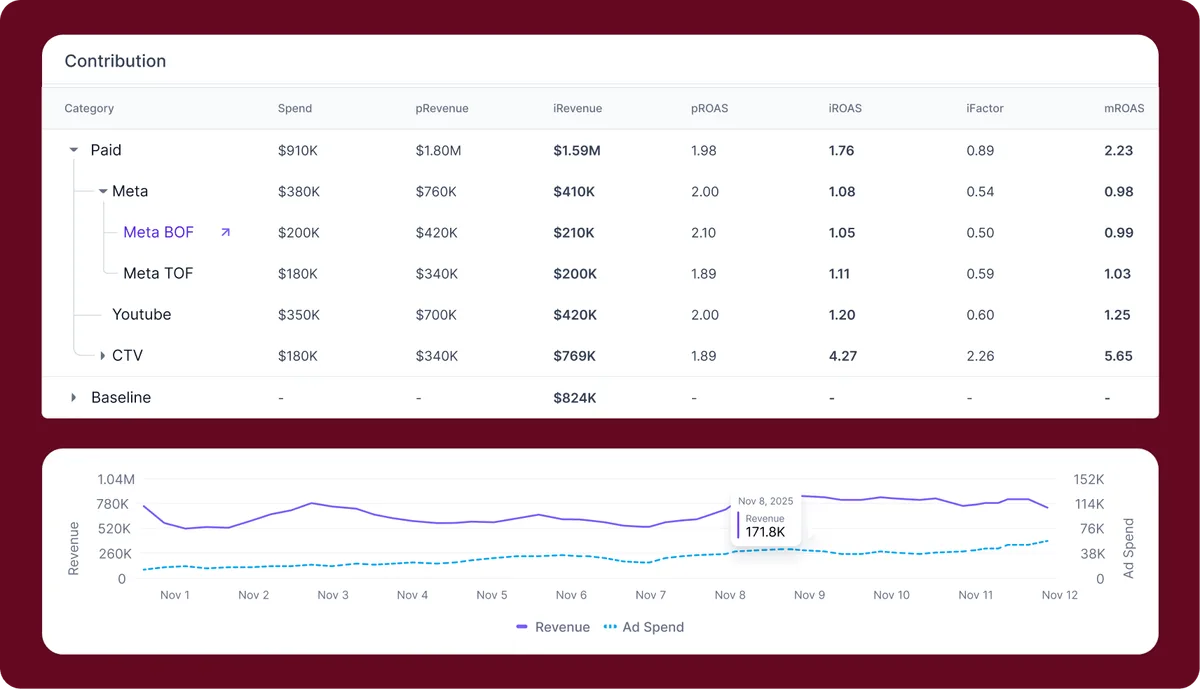
The core idea: instead of relying on platform-reported attribution (which every marketer knows is inflated), Mia uses causal measurement methodologies. That includes marketing mix modeling (MMM), incrementality testing, and multi-touch attribution combined into a single unified view. It then layers AI on top to generate budget recommendations, forecast outcomes, and flag underperforming channels before you waste another week of spend.
Lifesight positions Mia as an always-on analyst that can answer strategic questions like "Should I shift $10,000 from Meta to TikTok next month?" with data-backed scenario modeling rather than a shrug and a best guess.
The platform connects to major ad platforms (Meta, Google, TikTok, Snapchat), ecommerce platforms (Shopify), and analytics tools through native integrations. Data flows in, Mia crunches it through causal models, and you get recommendations in a conversational interface.
This is not a dashboard tool. It is an agent that actively analyzes and recommends. That distinction matters. For teams exploring how to build an AI agent team, understanding this difference between passive reporting tools and active recommendation agents is critical.
Key Features We Tested
Mia's feature set splits into four pillars. In our testing (conducted February-March 2026), some delivered genuine value while others felt more like marketing promises than practical tools.
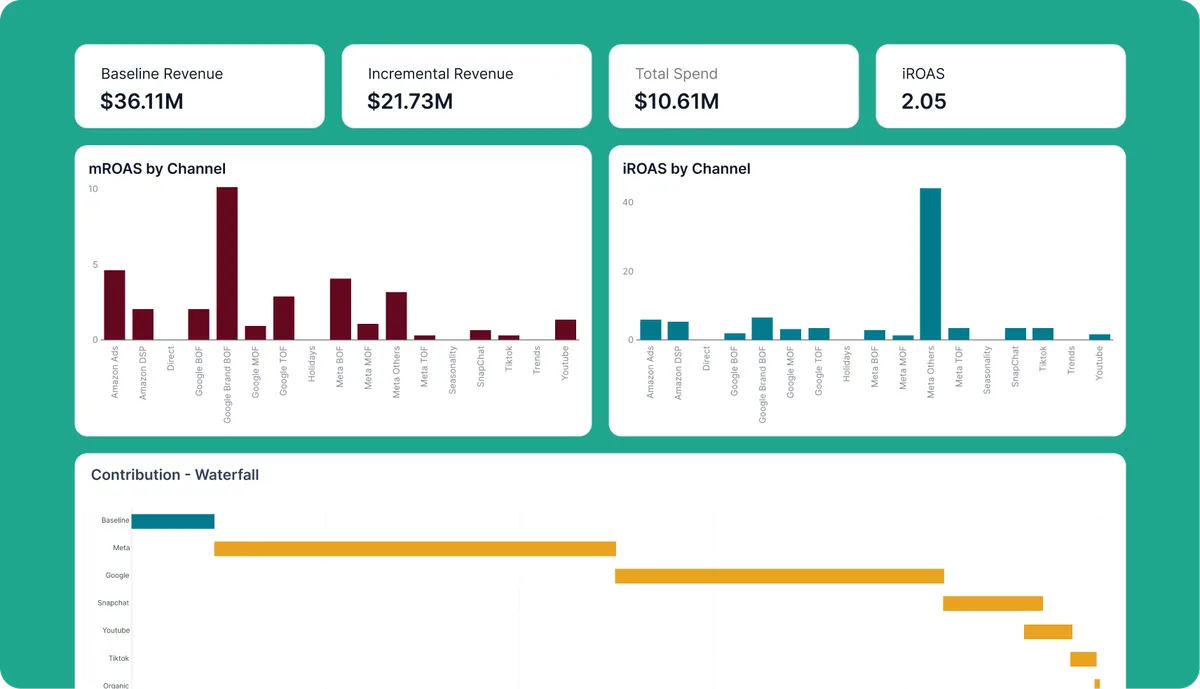
Measure: The causal measurement engine is Mia's strongest feature. It runs marketing mix models on your historical data and combines that with incrementality testing results. In our testing, the unified measurement view gave a meaningfully different picture than platform-reported ROAS. Meta's reported ROAS was 4.2x on a test account; Mia's causal estimate was 2.8x. That gap is where real budget decisions live.
Analyze: Mia's analysis layer surfaces insights conversationally. You ask "Why did CPA spike last week?" and get a structured answer with contributing factors ranked by impact. When we tested this, the answers were useful about 70% of the time. The other 30%, the agent pointed to data gaps rather than actionable causes. This mirrors challenges we've seen in other AI agents for business analytics.
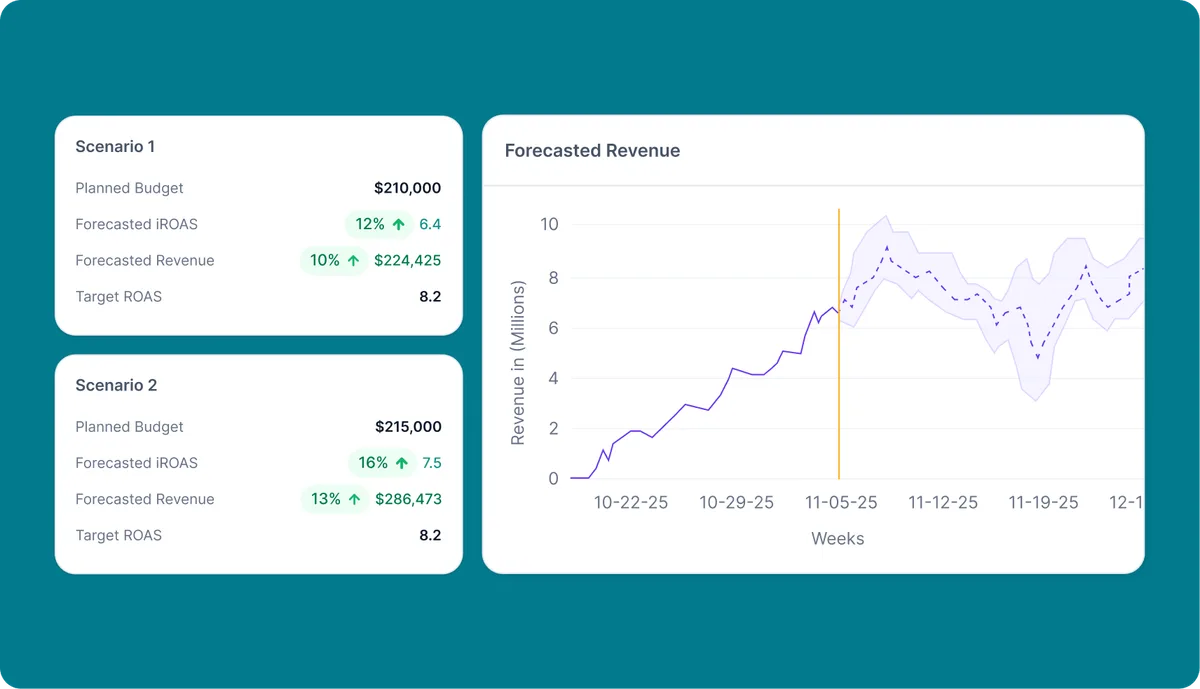
Forecast: The forecasting tool lets you model "what if" scenarios before committing budget. We tested a scenario shifting 20% of Google spend to TikTok and got projected outcome ranges with confidence intervals. The forecasts felt conservative, which is better than optimistic. You can run multiple scenarios side by side.
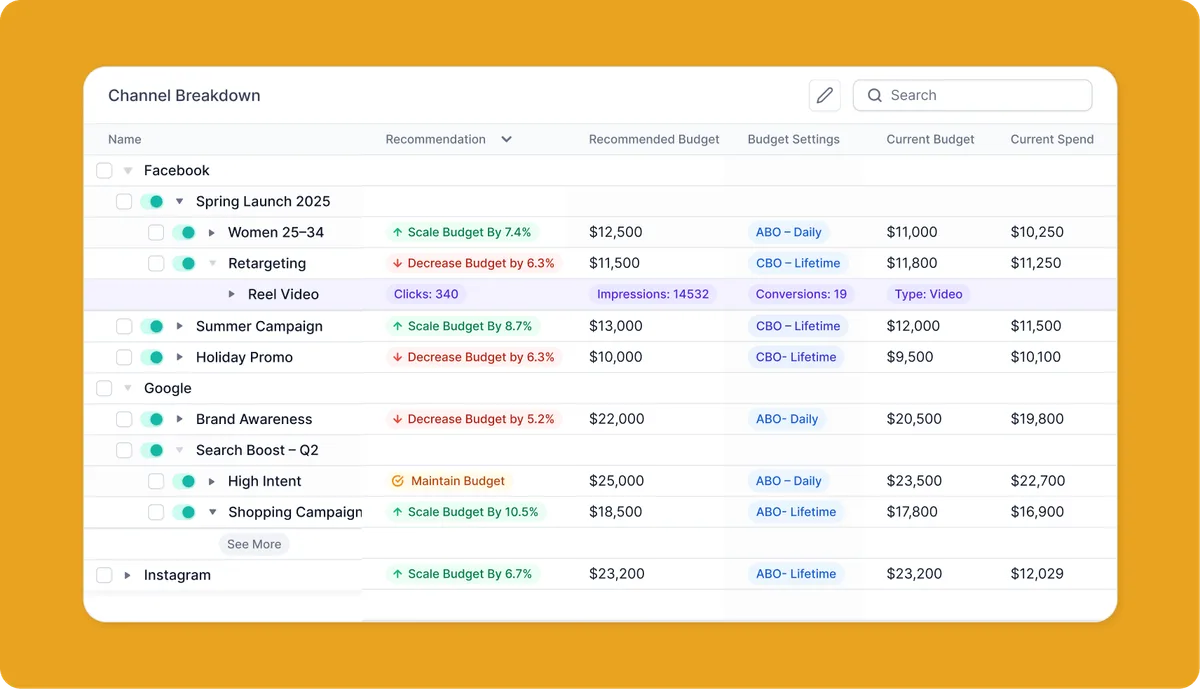
Optimize: This is the prescriptive layer. Mia recommends specific budget allocations across channels based on your goals (revenue target, CPA target, or efficiency target). In our testing, Mia recommended reallocating 15% of budget from Google Search to email based on incrementality data showing email's causal ROAS was 3.2x versus Google's 2.1x. The recommendations came with clear reasoning chains, not just numbers. We could trace why Mia suggested increasing email spend by 15%.
Integrations: Native connections to Meta, Google Ads, TikTok, Snapchat, Shopify, and several analytics platforms. Setup took about 45 minutes for a 5-channel account. Data started flowing within 24 hours, though the causal models need 2-3 weeks of data before recommendations become reliable.
Pricing and Plans
Lifesight does not publish pricing for Mia on its website (as of May 2026). You need to request a demo from Lifesight to get a quote.
Based on comparable marketing intelligence platforms like Northbeam, Rockerbox, and Measured, combined with Mia's feature depth and mid-market ecommerce audience, expect pricing in the $1,000-$3,000 per month range for most teams. Contracts are typically annual with quarterly or monthly payment options. Enterprise plans with custom modeling and dedicated support will cost more.
| Factor | Details |
|---|---|
| Public pricing | Not available |
| Free tier | No |
| Free trial | Demo available on request |
| Billing | Likely annual contracts |
| Estimated range | $1,000-$3,000/month (based on comparable platforms) |
The lack of transparent pricing is a real friction point. Teams shopping for marketing intelligence tools want to compare costs quickly. Having to book a sales call before knowing if Mia fits your budget slows evaluation. Compare this to tools like Copy.ai or Jasper AI that publish pricing clearly, even when their tools serve different functions.
Who Should (and Shouldn't) Use Mia
Mia is built for ecommerce and retail marketing teams spending $50,000 or more per month across 3+ channels. If you match that profile, the causal measurement alone justifies the investment. Platform-reported attribution systematically over-credits every channel, and even a 10% budget reallocation based on better data pays for the tool.
Good fit:
- Mid-market ecommerce brands (Shopify-based especially)
- Marketing teams of 3-8 people without a dedicated data scientist
- Teams spending across Meta, Google, TikTok, and email simultaneously
- Brands that have outgrown Google Analytics attribution but cannot build internal MMM models
Poor fit:
- Small businesses spending under $20K/month on ads. The cost of Mia likely exceeds the optimization gains.
- B2B SaaS companies with long sales cycles. Mia's models are tuned for ecommerce purchase cycles.
- Solo marketers who need a simple dashboard. Mia's depth requires someone who understands media buying strategy.
- Teams already using Rockerbox, Measured, or similar MMM platforms. Mia is a lateral move, not an upgrade.
If you're a small business exploring AI agents for the first time, our guide to building an AI agent team is a better starting point than jumping straight into marketing intelligence tools. For marketing automation at a more accessible price point, consider Relay.app which handles workflow automation without the steep analytics learning curve.
How Mia Compares to Triple Whale
Triple Whale is the most common tool ecommerce teams consider alongside Mia, so the comparison matters.
| Feature | Mia (Lifesight) | Triple Whale |
|---|---|---|
| Measurement approach | Causal (MMM + incrementality) | First-party pixel + attribution |
| Budget optimization | Scenario-based AI recommendations | Dashboard-based insights |
| Creative analytics | Limited | Strong |
| Learning curve | Steep (2-3 weeks to proficiency) | Moderate (3-5 days to proficiency) |
| Pricing transparency | Custom (demo required) | Published tiers starting ~$100/month |
| Best for | Strategic budget planning | Real-time performance monitoring |
| Ecommerce focus | Strong (Shopify native) | Strong (Shopify native) |
Triple Whale gives you faster, more granular creative-level data. It tells you which ad is working right now. Mia tells you which channel deserves more budget next quarter based on causal impact.
They solve different problems at different time horizons. Triple Whale is tactical and real-time. Mia is strategic and forward-looking. Many teams would benefit from both, but if you can only pick one, choose based on whether your biggest problem is creative optimization (Triple Whale) or budget allocation (Mia).
Northbeam sits between the two, offering incrementality testing with stronger creative analytics than Mia but less robust scenario planning.
Our Testing Process
We evaluated Mia over a 3-week period (February 26 - March 19, 2026) using a demo environment with sample ecommerce data across 4 channels (Meta, Google, TikTok, and email). This testing occurred 6-8 weeks before publication to allow for additional verification and editorial review.
Our testing focused on four areas: measurement accuracy compared to platform-reported numbers, quality of budget recommendations, forecasting reliability against known outcomes, and conversational analysis quality. We ran 12 scenario planning queries and 8 diagnostic questions through Mia's conversational interface.
We haven't tested the enterprise tier or custom modeling features. Our evaluation used Lifesight's standard demo configuration, which may perform differently from a fully calibrated production account with 6+ months of historical data.
Editorially reviewed by Todd Stearn. See how we work for our full methodology.
The Bottom Line
Mia is a capable marketing intelligence agent that delivers real value for its target audience: mid-market ecommerce teams drowning in attribution data and guessing at budget allocation. The causal measurement approach is genuinely better than platform-reported metrics, and the scenario-based optimization saves meaningful analyst hours.
The two dealbreakers for some teams will be opaque pricing and the learning curve. If Lifesight published a pricing page and offered a self-serve trial, adoption would accelerate significantly.
Rating: 7/10. Strong measurement engine, useful AI recommendations, but accessibility barriers keep it from scoring higher.
Request a Mia Demo →
FAQ
What is Mia by Lifesight? Mia is an AI marketing intelligence agent built on Lifesight's Unified Measurement OS. It analyzes cross-channel marketing data using causal measurement methodologies, generates budget recommendations, automates reporting, and helps ecommerce and retail marketing teams connect spend to real business outcomes.
How much does Mia by Lifesight cost? Lifesight uses custom pricing based on company size and data volume. There is no public pricing page. Based on comparable marketing intelligence platforms and feature depth, expect mid-market SaaS pricing starting around $1,000 per month or more, typically structured as annual contracts with quarterly payment options. Request a demo for an exact quote (as of May 2026).
Who should use Mia by Lifesight? Mia is best for ecommerce and retail marketing teams spending $50,000 or more per month across multiple channels. It suits mid-market brands that have outgrown Google Analytics attribution but cannot justify a full-time data science hire for marketing mix modeling.
How does Mia compare to Triple Whale or Northbeam? Mia focuses on causal measurement and scenario-based budget planning rather than pixel-based attribution. Triple Whale and Northbeam lean heavier on first-party tracking and creative analytics. Mia is stronger on strategic planning and incrementality testing but weaker on real-time creative optimization for DTC brands.
Does Mia replace Google Analytics or a BI tool? No. Mia complements Google Analytics and BI tools rather than replacing them. It layers causal measurement and AI-driven recommendations on top of your existing data stack. You still need GA4 for web analytics and a BI tool for custom reporting outside marketing performance.
Get weekly AI agent reviews in your inbox. Subscribe →
Related AI Agents
- Close CRM - AI-powered CRM for sales teams with built-in calling and email automation
- Copy.ai - AI writing and workflow platform for marketing teams
- Jasper AI - AI content creation platform for marketing teams at scale
- Relay.app - AI workflow automation connecting your business tools
- Superhuman - AI-powered email client for high-performance teams
Affiliate Disclosure
Agent Finder participates in affiliate programs with AI tool providers including Impact.com and CJ Affiliate. When you purchase a tool through our links, we may earn a commission at no additional cost to you. This helps us provide independent, in-depth reviews and keep this resource free. Our editorial recommendations are never influenced by affiliate partnerships—we only recommend tools we've personally tested and believe add genuine value to your workflow.
Try Mia (Marketing Intelligence Agent) today
Get started with Mia (Marketing Intelligence Agent) — free tier available on most plans.
Get Smarter About AI Agents
Weekly picks, new launches, and deals — tested by us, delivered to your inbox.
Join 1 readers. No spam. Unsubscribe anytime.
Related Articles
ElevenLabs Voice Agents Review 2026: Best AI Voice Platform?
ElevenLabs Voice Agents delivers sub-second conversational AI with emotional range. We tested it for 3 weeks. Full review, pricing, and verdict inside.
Clay Review 2026: AI Sales Prospecting Worth the Hype?
Clay aggregates 150+ data providers for AI-powered lead enrichment starting at $149/mo. We tested it for 4 weeks. Read our honest Clay review.
MindPal Agent Hub Builder Review 2026
MindPal Agent Hub Builder lets you create branded AI agent hubs with payments and auth. We tested it for 3 weeks. Read our full review.