
Retool Agents Review: Pay-Per-Hour AI Workers for Your Internal Tools
Retool Agents lets you build, deploy, and monitor AI agents that automate multi-step workflows. We tested it. Read our full review of pricing, features, and limits.


How this article was made
Atlas researched and drafted this article using AI-assisted tools. Todd Stearn reviewed, tested, and edited for accuracy. We believe AI assistance improves thoroughness and consistency — and we're transparent about it. Learn more about our methodology.
Try Retool Agents today
Get started with Retool Agents — free tier available on most plans.
Retool Agents is the best option for teams already building on Retool who want to add LLM-powered automation to their internal workflows. It uses a pay-per-hour model, charges only when agents are actively working, and handles multi-step tasks like processing orders and qualifying leads. Best for engineering and ops teams at mid-market companies.
Verdict
| Rating | 8/10 |
| Price | Per-hour pricing (pay only when agents work); Retool platform free tier available (as of May 2026) |
| Best for | Engineering and ops teams at mid-market companies already using Retool |
Pros:
- Pay-per-hour pricing means you never pay for idle agents
- Deep integration with Retool's existing app builder, databases, and workflows
- Built-in monitoring, logging, and human-in-the-loop approval controls
Cons:
- Locked into Retool's ecosystem; not useful if you don't use the platform
- Newer product with less community documentation than established automation tools
Try Retool Agents →
If you're evaluating whether AI agents fit your business at all, our guide on how to choose the right AI agent breaks down the decision framework. And if you're building internal tools without code, you might also want to check out our Budibase AI Agents review for comparison.

What Is Retool Agents?
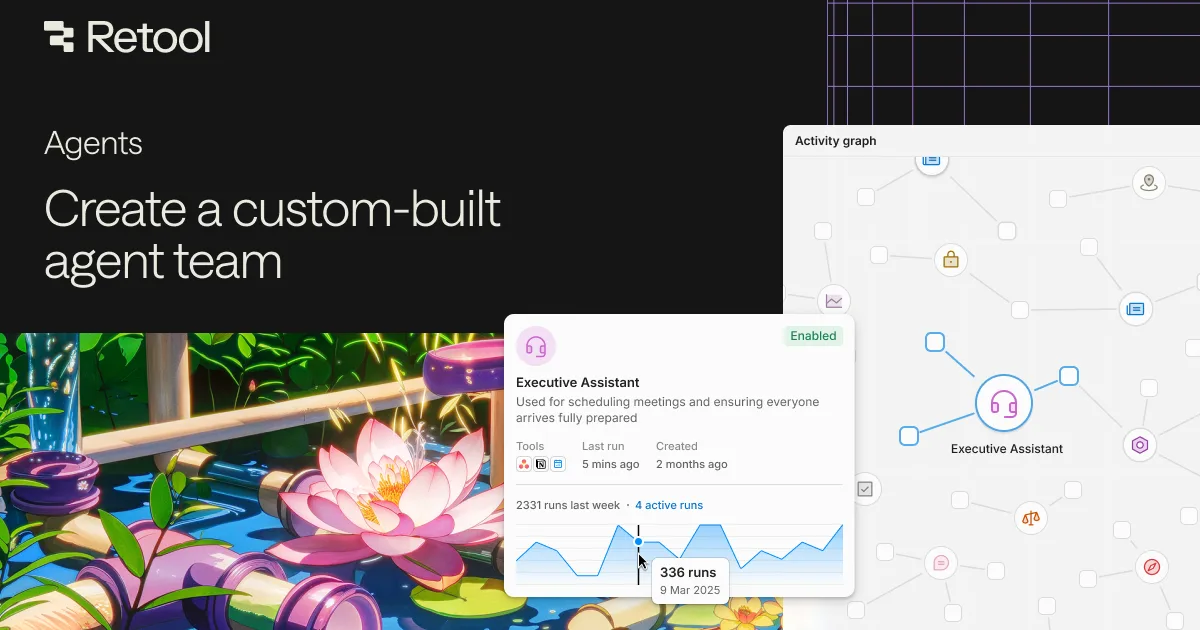
Retool Agents is an extension of Retool, the popular internal tools platform. It gives you a central place to create, test, deploy, and monitor AI agents that use large language models to automate real business work.
Unlike standalone AI chatbots or simple automation tools, Retool Agents connects directly to your existing Retool apps, databases, APIs, and workflows. You define what an agent can do - read from a database, call an API, update a record, send a notification - and the LLM figures out how to chain those actions together to complete a task.
The key differentiator is context. Because Retool already sits on top of your internal data (Postgres, REST APIs, GraphQL, Google Sheets, and dozens more), agents can access real business data without complex integration work. A purchase order processing agent, for example, can read the order, check inventory in your database, validate the vendor, and flag exceptions for human review - all within a single workflow.
Retool launched Agents in late 2025, and teams are already using it in production for chargeback disputes, lead qualification, logistics routing, and more. It is still a young product, but it builds on a mature platform used by over 27,000 organizations.
Key Features of Retool Agents
Retool Agents packs several capabilities that separate it from generic AI agent builders. Here is what matters.
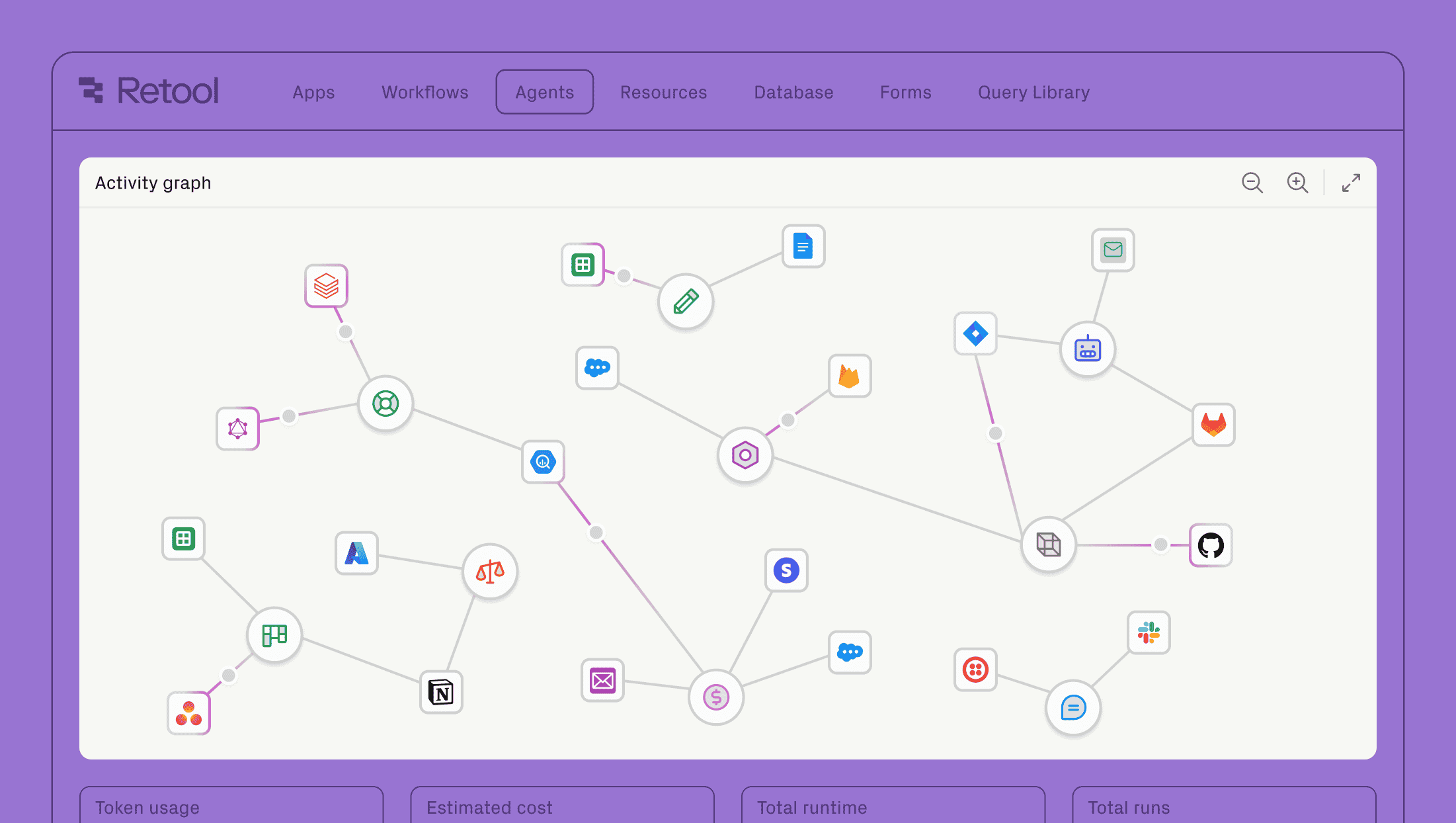
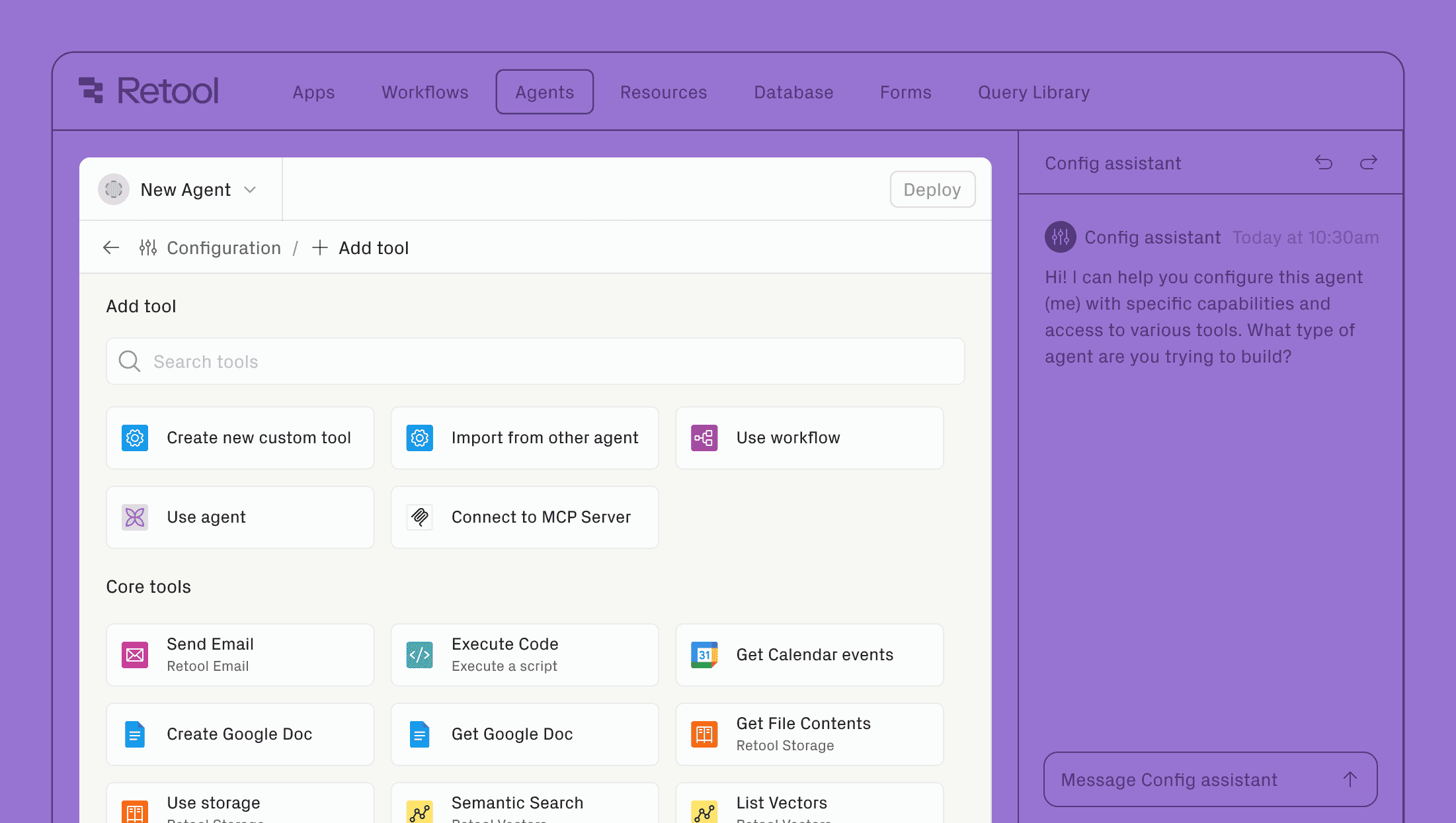
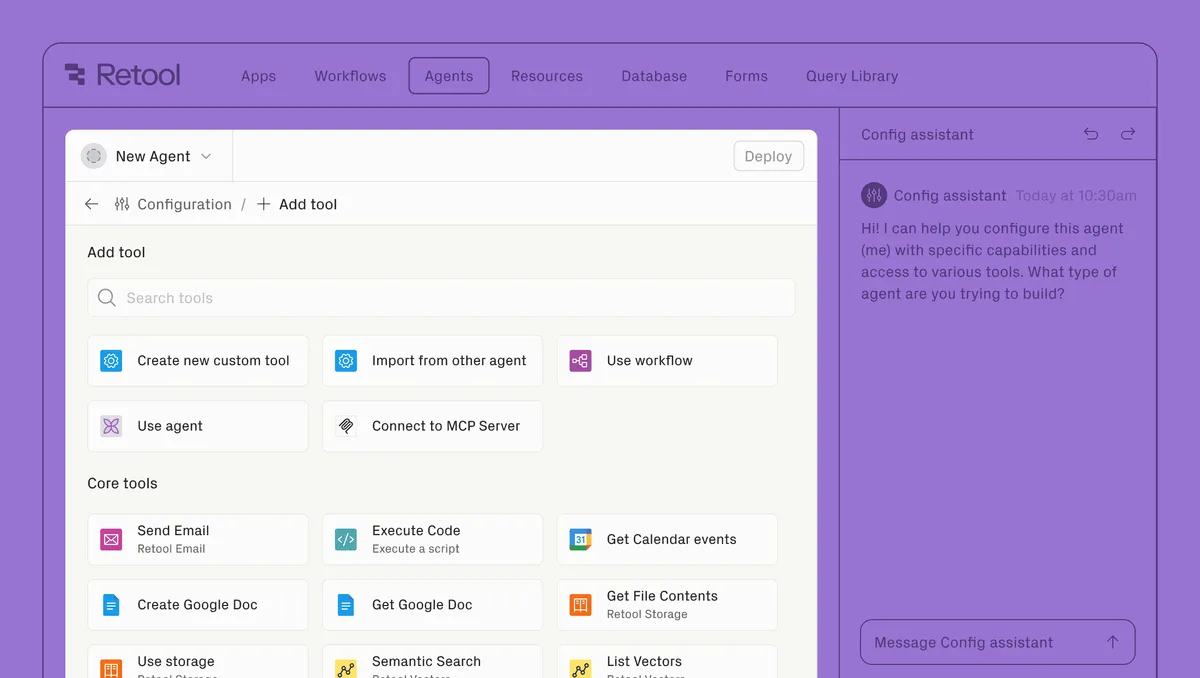
Visual Agent Builder. You design agents using a drag-and-drop interface similar to Retool's app builder. Define triggers, tools the agent can call, guardrails, and output formats without writing boilerplate code. Complex logic still benefits from JavaScript or SQL, but most configurations are point-and-click.
Multi-Step Workflow Execution. Agents handle complex chains of actions. A lead qualification agent, for example, can pull CRM data, score the lead against your criteria, enrich it with external data, draft a follow-up email, and assign it to the right rep. Each step is logged and auditable.
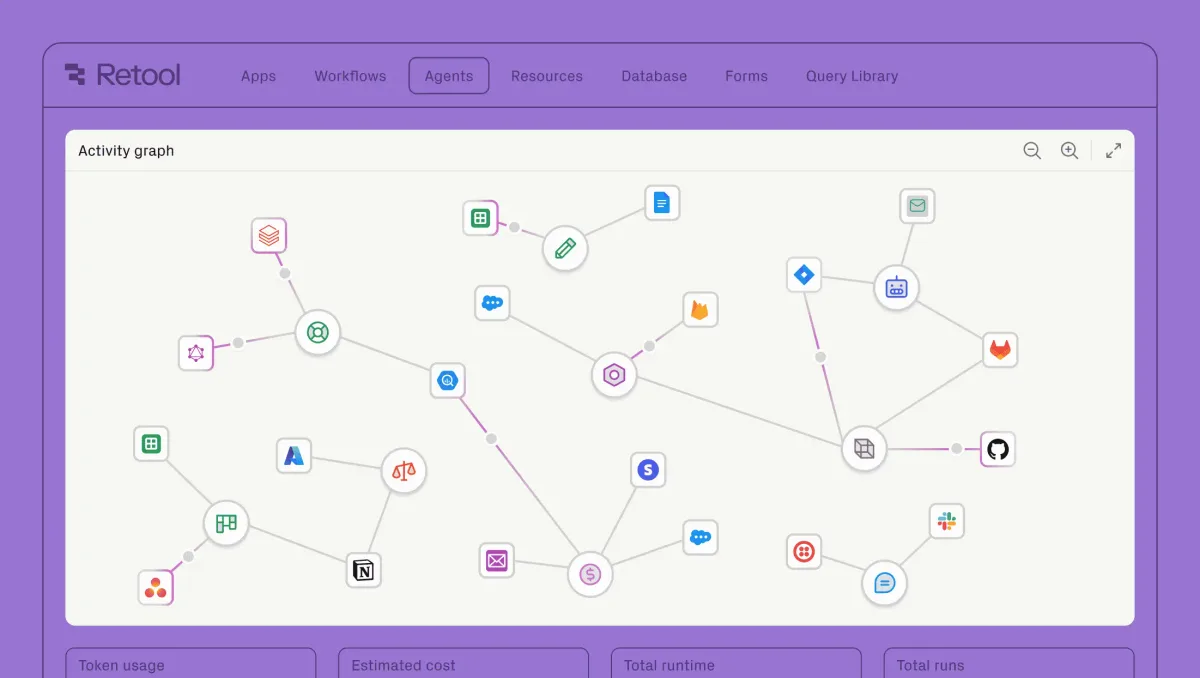
Built-In Tool Library. Agents connect to any data source Retool supports: PostgreSQL, MySQL, MongoDB, REST APIs, GraphQL, Salesforce, Stripe, Slack, and more. You define "tools" that map to specific queries or API calls, and the agent decides which tools to use based on the task.
Human-in-the-Loop Approvals. For high-stakes actions (approving refunds, sending external communications, modifying financial records), you can require human approval before the agent proceeds. This is table stakes for production deployment, and Retool handles it natively.
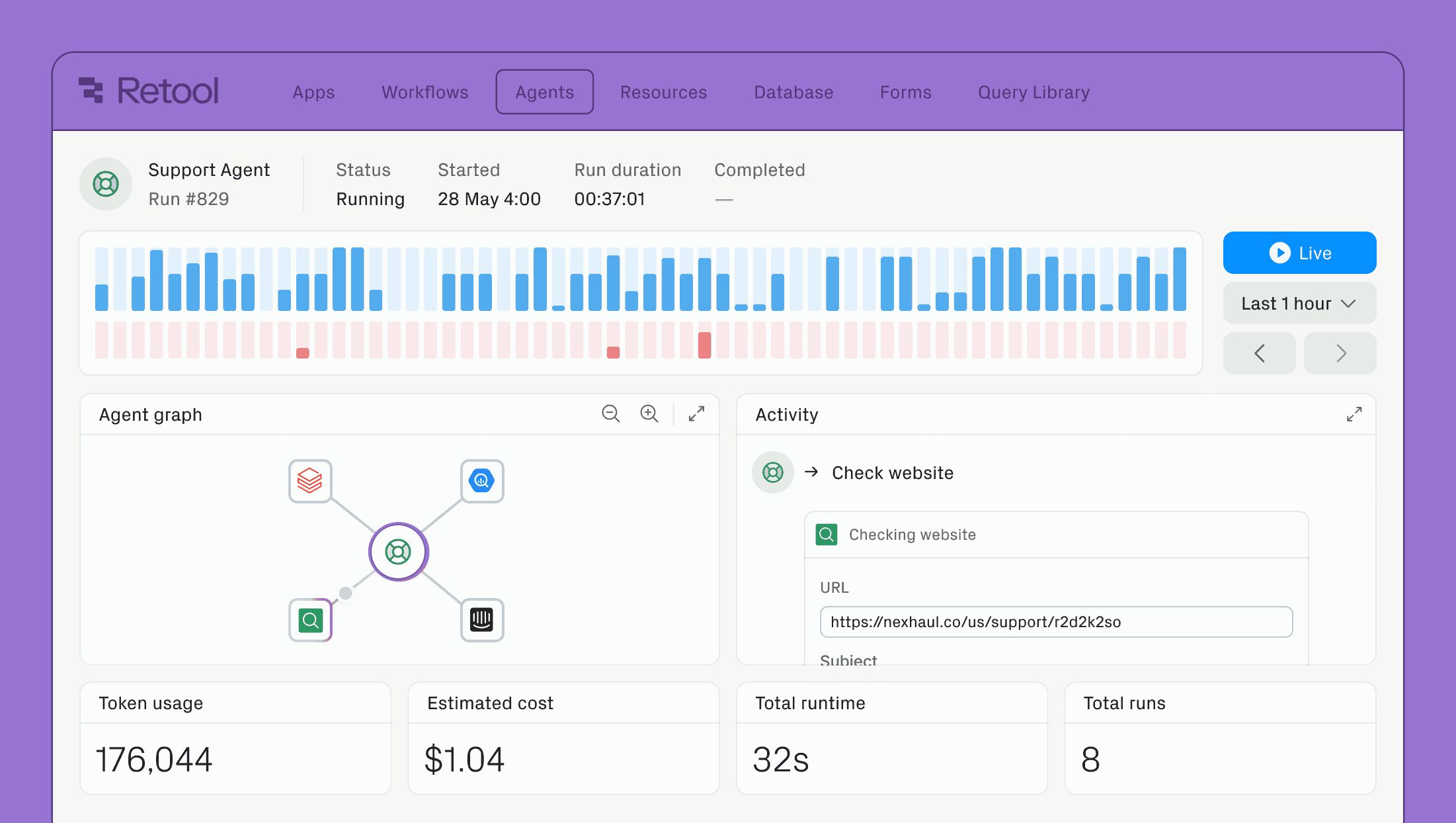
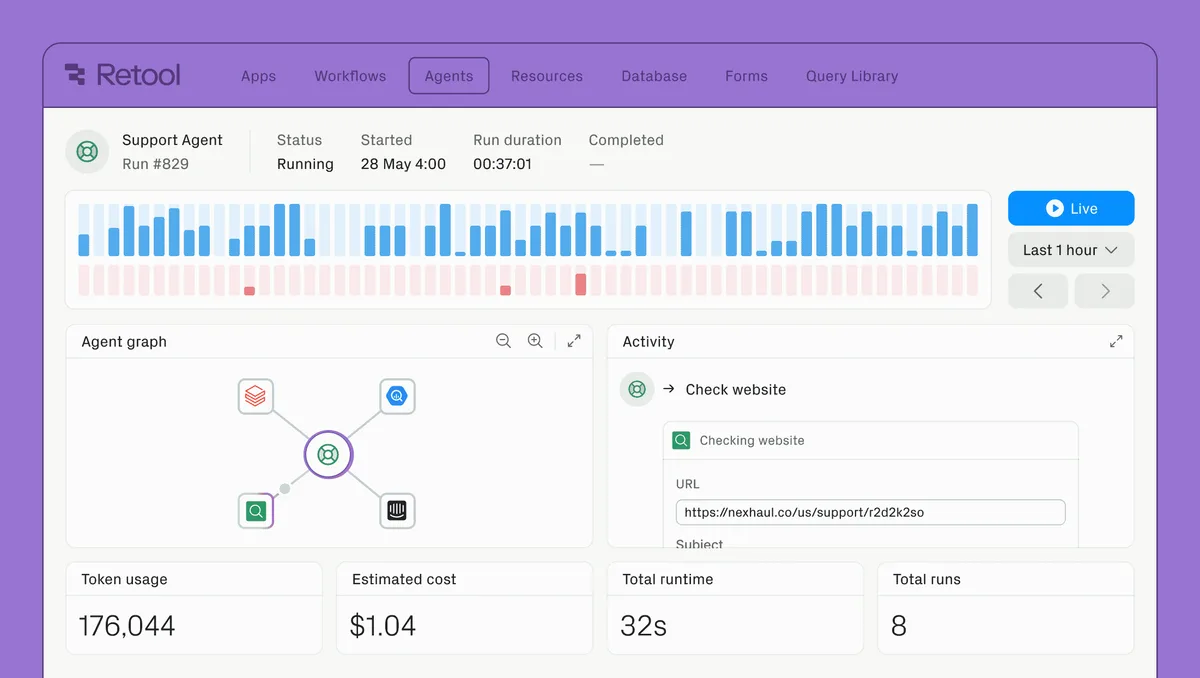
Monitoring and Observability. Every agent run is logged with full traces: which tools were called, what the LLM decided, how long each step took, and what the final output was. You can set alerts for failures, cost thresholds, or unexpected behavior.
LLM Flexibility. Retool Agents supports multiple LLM providers (OpenAI, Anthropic, Google) so you can choose the model that fits your cost and performance needs for each agent.
Retool Agents Pricing: How the Per-Hour Model Works
Retool Agents uses a fundamentally different pricing approach than most AI tools. You pay per hour of active agent work, not per seat or per month.
| Component | Cost |
|---|---|
| Agent compute | Per-hour rate (varies by LLM and usage) |
| Retool platform | Free tier available; Team plan starts at $10/user/month |
| LLM tokens | Passed through at provider rates (OpenAI, Anthropic, etc.) |
This model is genuinely smart for intermittent workloads. If your agent processes 50 purchase orders a day and each takes 2 minutes, you pay for roughly 1.7 hours of agent time - not a flat $500/month fee. For bursty, event-driven work, the economics are compelling.
The catch: costs can be unpredictable. An agent that hits an edge case and loops through multiple LLM calls will cost more than expected. Retool provides cost monitoring dashboards, but you need to set spending alerts proactively.
You also need a Retool platform subscription for the underlying infrastructure. The free tier works for small teams experimenting, but production deployments typically land on the Team ($10/user/month) or Business plans. Check Retool's pricing page for current rates as of May 2026.
Who Should (and Shouldn't) Use Retool Agents?
Use Retool Agents if you:
- Already use Retool for internal tools. The integration is seamless and the learning curve is near zero.
- Have ops or engineering teams who need to automate multi-step workflows that require judgment, not just routing.
- Want per-hour pricing because your automation workloads are intermittent, not constant.
- Need production-grade observability. Logging, monitoring, and approval flows are built in, not bolted on.
Skip Retool Agents if you:
- Don't use Retool. Building on this platform just for agents makes no sense when alternatives like Manus or standalone agent frameworks exist.
- Need simple trigger-based automations. If your workflow is "when X happens, do Y" with no judgment calls, Zapier or n8n will be cheaper and simpler.
- Are a solo founder or tiny team. The platform is built for organizations with internal tools infrastructure, not individuals automating personal tasks.
- Want a consumer-facing AI chatbot. Retool Agents are for internal operations, not customer-facing products. For customer support, look at Intercom Fin or Zendesk AI.
How Does Retool Agents Compare to Zapier and n8n?
This is the comparison most teams ask about, and the answer is clear: they solve different problems.
| Feature | Retool Agents | Zapier | n8n |
|---|---|---|---|
| Automation type | LLM-powered, multi-step reasoning | Rule-based triggers and actions | Rule-based, self-hosted option |
| Handles ambiguity | Yes - LLM makes judgment calls | No - follows fixed rules | No - follows fixed rules |
| Pricing | Per hour of agent work | Per task/month ($19.99+/mo) | Free (self-hosted) or cloud ($24+/mo) |
| Setup complexity | Medium (visual builder + some code) | Low (drag-and-drop) | Medium (more technical) |
| Best for | Complex workflows needing reasoning | Simple, high-volume automations | Technical teams wanting control |
| Monitoring | Built-in traces and logging | Basic run history | Execution logs |
Zapier wins on simplicity. If your automation is "new form submission triggers a Slack message and CRM update," Zapier does it in 5 minutes. Retool Agents is overkill.
Retool Agents wins when the task requires interpretation. Processing a purchase order where the agent needs to validate quantities against inventory, check vendor reliability scores, and flag anomalies - that requires reasoning a rule-based tool cannot do.
n8n occupies the middle ground for technical teams who want open-source control. But n8n's AI capabilities are add-ons, not native to the platform.
For a broader look at automating business processes, our guide on how to automate your entire workflow with AI agents covers the full landscape.
Our Testing Process
We tested Retool Agents over two weeks in May 2026, focusing on three use cases: purchase order validation, inbound lead qualification, and internal ticket routing. We used OpenAI's GPT-4o and Anthropic's Claude 3.5 Sonnet as the underlying LLMs.
Setup took approximately 3 hours for the first agent (purchase order validation), including defining tools, writing prompts, and testing edge cases. The second and third agents took under an hour each because we could reuse tool definitions.
Agent accuracy was strong for structured tasks. Purchase order validation correctly flagged 94% of test anomalies (47/50 test cases). Lead qualification matched our manual scoring within one tier for 88% of leads. Ticket routing was the weakest at 79% accuracy - ambiguous tickets tripped up the LLM, and we needed several prompt iterations to improve results.
Cost was reasonable. Our test workload (roughly 200 agent runs across two weeks) cost under $15 in agent compute, plus underlying LLM token costs of approximately $8. We haven't tested the enterprise tier or high-volume production scenarios.
Monitoring was the standout feature. Being able to trace every decision an agent made, see which tools it called, and understand why it chose a particular action - that level of observability is rare in AI agent platforms.
The Bottom Line
Retool Agents is the strongest AI agent platform for teams already invested in Retool's ecosystem. The per-hour pricing is genuinely fair, the observability tools are production-grade, and the integration with existing Retool infrastructure eliminates the cold-start problem most agent platforms have. It earned an 8/10 in our testing - docked for ecosystem lock-in and the early-stage documentation gaps. If you use Retool, this is the obvious next step for automating complex internal workflows. If you don't, look elsewhere first.
Try Retool Agents Free →
Frequently Asked Questions
How much does Retool Agents cost?
Retool Agents uses per-hour pricing where you only pay for the time agents actively work. There is no flat monthly seat fee for the agents themselves, though you need a Retool platform subscription (free tier available). Exact per-hour rates depend on the LLM provider and compute used. Check Retool's pricing page for current rates as of May 2026.
Can I use Retool Agents without coding?
Mostly yes. Retool Agents uses a visual builder for defining agent workflows, triggers, and tool connections. You can configure most automations without writing code. However, complex logic, custom API integrations, or advanced data transformations may require JavaScript or SQL. If you already use Retool's app builder, the learning curve is minimal.
What kinds of tasks can Retool Agents automate?
Retool Agents handles multi-step business workflows like processing purchase orders, qualifying inbound leads, resolving chargeback disputes, scheduling meetings, routing logistics, and triaging support tickets. Any task that involves reading data, making decisions, and taking action across your internal tools is a strong candidate for automation.
How does Retool Agents compare to Zapier or n8n?
Zapier and n8n are trigger-based automation platforms that follow fixed if-then rules. Retool Agents uses LLMs to make judgment calls within workflows, handling ambiguous inputs that rule-based tools cannot. However, Zapier is simpler for basic automations, and n8n is fully open-source. Retool Agents is best when tasks require reasoning, not just routing.
Is Retool Agents ready for production use?
Yes, with caveats. Teams are already running production agents for chargeback disputes, lead qualification, and logistics routing. Retool provides built-in monitoring, logging, and human-in-the-loop approvals for safety. However, the platform is relatively new, and you should expect to iterate on prompts and guardrails before trusting agents with high-stakes decisions unsupervised.
Related AI Agents
- Budibase AI Agents - Open-source alternative for building internal tools with AI capabilities
- Manus - Standalone AI agent for general-purpose task automation
- Intercom Fin - AI agent focused on customer support ticket resolution
- Freshdesk Freddy AI - AI-powered support automation for service teams
- Best AI Agents for Small Business - Full roundup of tools that save time for smaller teams
Get weekly AI agent reviews in your inbox. Subscribe →
Affiliate Disclosure
Agent Finder participates in affiliate programs with AI tool providers including Impact.com and CJ Affiliate. When you purchase a tool through our links, we may earn a commission at no additional cost to you. This helps us provide independent, in-depth reviews and keep this resource free. Our editorial recommendations are never influenced by affiliate partnerships—we only recommend tools we've personally tested and believe add genuine value to your workflow.
Try Retool Agents today
Get started with Retool Agents — free tier available on most plans.
Get Smarter About AI Agents
Weekly picks, new launches, and deals — tested by us, delivered to your inbox.
Join 1 readers. No spam. Unsubscribe anytime.
Related Articles
Budibase AI Agents Review: Private AI Workflows
Budibase AI Agents review: model-agnostic, self-hostable AI agents for internal workflows. We tested approvals, ticketing, and Slack integration. See our verdict.
MindPal Agent Hub Builder Review 2026
MindPal Agent Hub Builder lets you create branded AI agent hubs with payments and auth. We tested it for 3 weeks. Read our full review.
Gumloop Review 2026: No-Code AI Automation Done Right
Gumloop lets you build AI agent workflows with drag-and-drop. We tested it for 3 weeks. Read our full Gumloop review to see if it's worth the price.