
Sudowrite Review 2026: AI Fiction Writing Partner
Sudowrite review: AI writing tool built for fiction authors. We tested it for novels, screenplays, and poetry. $19/mo starting price. See our honest verdict.


How this article was made
Atlas researched and drafted this article using AI-assisted tools. Todd Stearn reviewed, tested, and edited for accuracy. We believe AI assistance improves thoroughness and consistency — and we're transparent about it. Learn more about our methodology.
Try Sudowrite today
Get started with Sudowrite — free tier available on most plans.
Sudowrite is the best AI writing tool built specifically for fiction authors. It generates prose that actually sounds like fiction, expands thin scenes with sensory detail, and builds full story outlines. Pricing starts at $19/month (as of May 2026). Best for novelists, screenwriters, and short story writers who need a creative partner, not a content mill.
Quick Assessment
| Rating | 8/10 |
| Price | $19-$89/month |
| Best for | Fiction authors writing novels, short stories, and screenplays |
Pros:
- Prose quality trained on published fiction sounds genuinely literary
- Story Engine builds full chapter outlines and drafts from a synopsis
- Expand and Describe tools add specific sensory detail, not generic filler
Cons:
- Useless for nonfiction, marketing, or business writing
- Voice consistency drifts on longer projects without careful prompting
Try Sudowrite Free →
If you're weighing Sudowrite against general-purpose AI writing tools, check out our Writesonic review for a comparison on the nonfiction side. For grammar and editing specifically, our Grammarly review covers that angle.
What Is Sudowrite?
Sudowrite is an AI writing assistant designed exclusively for fiction. It uses proprietary language models fine-tuned on published novels, short stories, and screenplays to generate creative prose that reads like actual fiction rather than blog content dressed up in quotation marks.
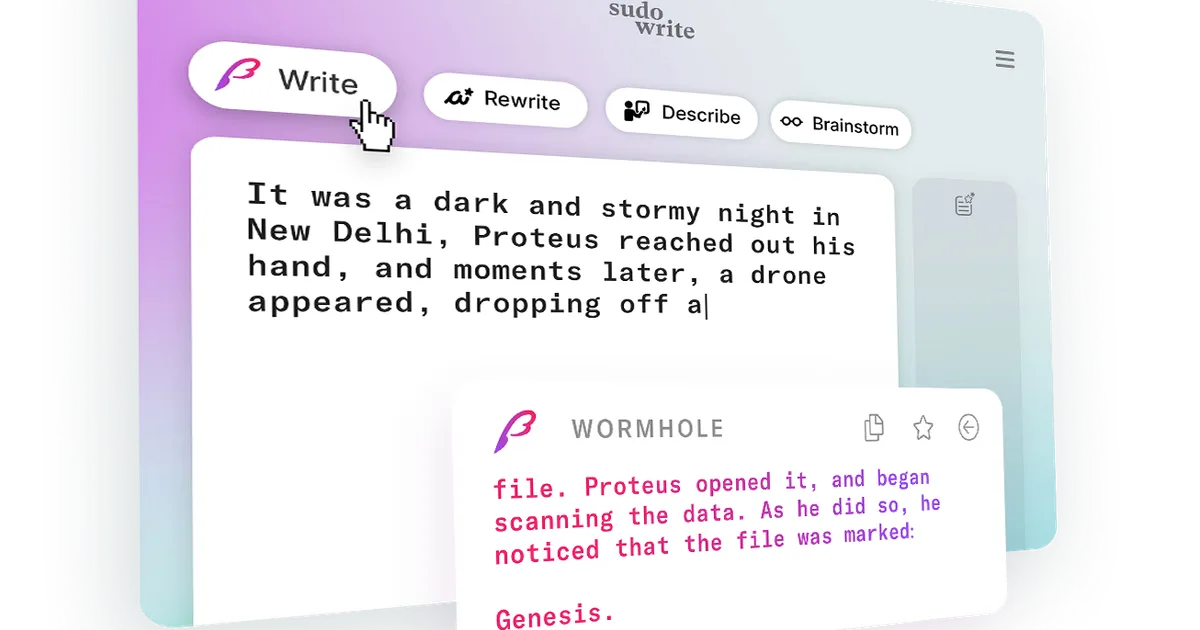
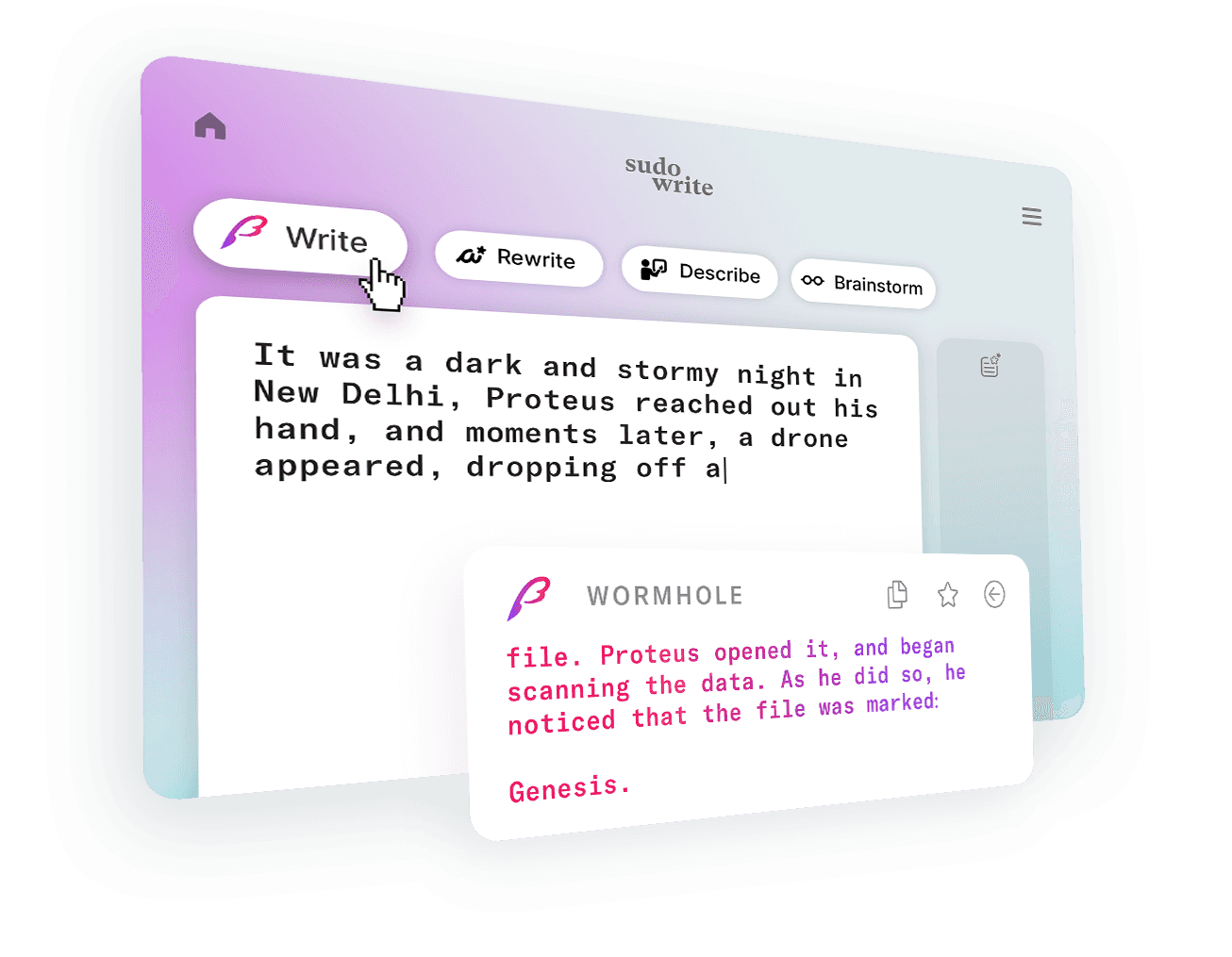
Founded in 2020 by James Yu and Amit Gupta, Sudowrite targets a specific audience that most AI writing tools ignore: novelists, poets, and screenwriters. The tool sits in your browser as a distraction-free editor where you paste or write your work-in-progress, then use AI features to brainstorm ideas, expand scenes, describe settings, and push through writer's block.
What separates Sudowrite from tools like Rytr or Copy.ai is training data and intent. General AI writers optimize for clarity, SEO, and conversion. Sudowrite optimizes for narrative tension, sensory language, and voice matching. When you ask it to expand a paragraph, it doesn't add filler. It adds the smell of rain on asphalt, the way a character fidgets with a ring, the creak of a floorboard.
That said, this laser focus is also its limitation. If you need blog posts, ad copy, or email sequences, Sudowrite is the wrong tool entirely. It's a fiction specialist, and it acts like one.
Key Features That Actually Matter
Sudowrite packs over a dozen AI features, but five carry the weight. We tested each during a three-week evaluation writing a sci-fi novella and a literary short story. Tested April 2026.
Story Engine is Sudowrite's flagship. You feed it a synopsis, character descriptions, and tone preferences. It generates a full chapter-by-chapter outline, then drafts each chapter. In our testing, Story Engine produced a 12-chapter outline for a 50,000-word novella in under 10 minutes. The output needed revision, but the structural logic held. It understood rising action, midpoint reversals, and pacing beats.
Expand takes a thin paragraph and adds sensory detail, interior monologue, or environmental description. We gave it a 40-word action scene and got back 200 words with specific physical sensations, sound effects, and spatial awareness. Hit rate was roughly 70% useful on first generation.
Describe generates five sensory descriptions (sight, sound, smell, taste, touch) for any highlighted noun or scene. This is the feature we used most often. It broke us out of lazy adjective habits and suggested concrete details we wouldn't have reached for.
Brainstorm generates plot directions, character motivations, or scene ideas when you're stuck. You highlight a passage, ask "what happens next," and get 5-10 branching possibilities. Quality varies, but 2-3 options per batch were genuinely surprising.
Rewrite offers tonal variations of any selected text. You can shift a passage from formal to conversational, from sparse to lush, or match a specific author's style. We tested Hemingway, Toni Morrison, and Raymond Chandler style prompts. The Chandler imitation was uncannily good. Morrison less so.
One feature we didn't find useful: Feedback. It provides high-level critiques of pacing, dialogue, and description balance. The comments were too generic to act on. Stick with beta readers or a developmental editor for real feedback.
Pricing and Plans: What You Actually Pay
Sudowrite pricing is straightforward and word-count based. All plans include every feature. The only difference is how many AI-generated words you get per month.
| Plan | Monthly Price | AI Words/Month | Best For |
|---|---|---|---|
| Hobby & Short Story | $19/mo | 225,000 | Short story writers, casual users |
| Professional | $29/mo | 350,000 | Active novelists, one project at a time |
| Max | $89/mo | 1,500,000 | Full-time authors, multiple projects |
Prices as of May 2026, sourced from Sudowrite's pricing page. Annual billing drops costs by roughly 17%.
The Hobby plan is generous enough for most writers. In our testing, a single 5,000-word chapter used approximately 8,000-12,000 AI words (including regenerations and discarded output). At that rate, 225,000 words covers 18-28 chapters per month. Unless you're generating multiple novel drafts simultaneously, you won't hit the cap.
The Professional plan at $29/month is the sweet spot. It's $10 more for 55% more words, which makes sense if you're using Story Engine heavily for full chapter drafts.
The Max plan at $89/month is overkill for most individual writers. It makes sense for authors running multiple pen names or ghostwriters handling several clients.
There's a free trial that lets you test features with limited word credits. No credit card required. That's where we'd recommend starting.
Who Should (and Shouldn't) Use Sudowrite
Sudowrite is perfect for: Fiction writers who struggle with blank-page paralysis. Novelists who can outline but freeze at the prose stage. Short story writers who want richer sensory language. Screenwriters who need to brainstorm plot variations quickly. NaNoWriMo participants who need volume without sacrificing quality.
Sudowrite is wrong for: Anyone writing nonfiction. Marketers. Bloggers. Business writers. Academic writers. If your content doesn't have characters, scenes, and narrative arcs, Sudowrite's models will fight you. Its training data is fiction, and the output shows it.
It's also wrong for writers who want AI to do the creative thinking for them. Sudowrite is a collaborator, not a ghost. You still need voice, vision, and editorial judgment. The tool amplifies your ideas. It doesn't replace them.
One honest caveat: voice consistency drifts on longer projects. We noticed that by chapter 8 of our novella, the AI-generated prose had subtly shifted tone from our opening chapters. This required manual correction. Experienced writers will catch it. Newer writers might not.

How Sudowrite Compares to Jasper and ChatGPT for Fiction
This is the comparison most fiction writers ask about. Here's how it plays out based on our testing.
Sudowrite vs. ChatGPT for fiction writing: ChatGPT can write fiction, but it defaults to flat, explanatory prose. When we gave both tools the same scene prompt, ChatGPT produced serviceable text that read like a synopsis. Sudowrite produced prose with rhythm, sensory texture, and implied emotion. ChatGPT tells. Sudowrite shows. For fiction specifically, Sudowrite wins decisively.
Sudowrite vs. Jasper for creative writing: Jasper is a marketing-first tool that added fiction templates as an afterthought. Its fiction output reads like ad copy with character names inserted. Sudowrite's fiction reads like fiction. There's no real comparison here if creative writing is your goal.
Sudowrite vs. NovelAI: NovelAI is the closest competitor. It offers similar fiction-trained models with more customization over AI parameters. NovelAI gives you more control at the cost of a steeper learning curve. Sudowrite gives you a cleaner, more guided experience. We prefer Sudowrite for structured novel writing and NovelAI for experimental or interactive fiction.
For writers evaluating AI writing tools across categories, our Anyword review covers the marketing-copy side, and our Blaze AI review handles content creation for solopreneurs.
Our Testing Process
We tested Sudowrite over three weeks in April 2026. Our process included:
- Writing a 12-chapter sci-fi novella outline using Story Engine, then generating full chapter drafts
- Expanding 15 thin scenes using the Expand tool and rating output quality
- Running Describe on 30 nouns and objects to evaluate sensory detail accuracy
- Brainstorming 10 plot forks and evaluating creative quality of suggestions
- Rewriting 8 passages in different author styles to test voice matching
- Tracking word credit usage across all features
We haven't tested the Max plan's priority support or multi-project workflows, since our testing focused on the Professional tier. All findings reflect the $29/month plan.
Editorially reviewed by Todd Stearn. Full methodology at how we work.
The Bottom Line
Sudowrite is the strongest AI writing tool for fiction authors in 2026. Its prose quality, scene expansion, and story structure tools are purpose-built for the creative writing process. At $19-$29/month, it costs less than a single hour of developmental editing and delivers daily value. If you write fiction and you're not using Sudowrite, you're leaving your best creative partner on the table.
The tradeoffs are real. It's useless for nonfiction. Voice drifts on long projects. The Feedback feature needs work. But for what it does well, nothing else comes close.
Try Sudowrite Free →
Frequently Asked Questions
Is Sudowrite good for writing novels?
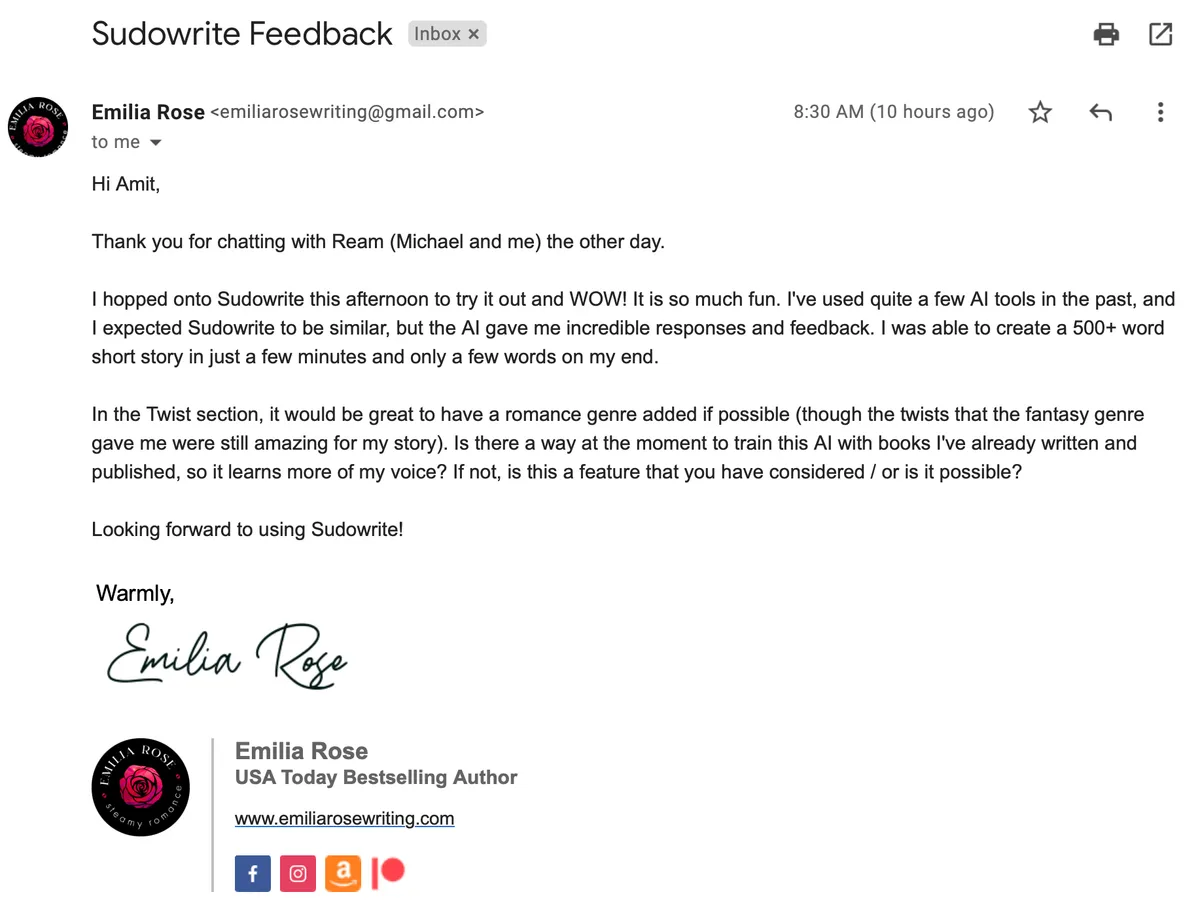
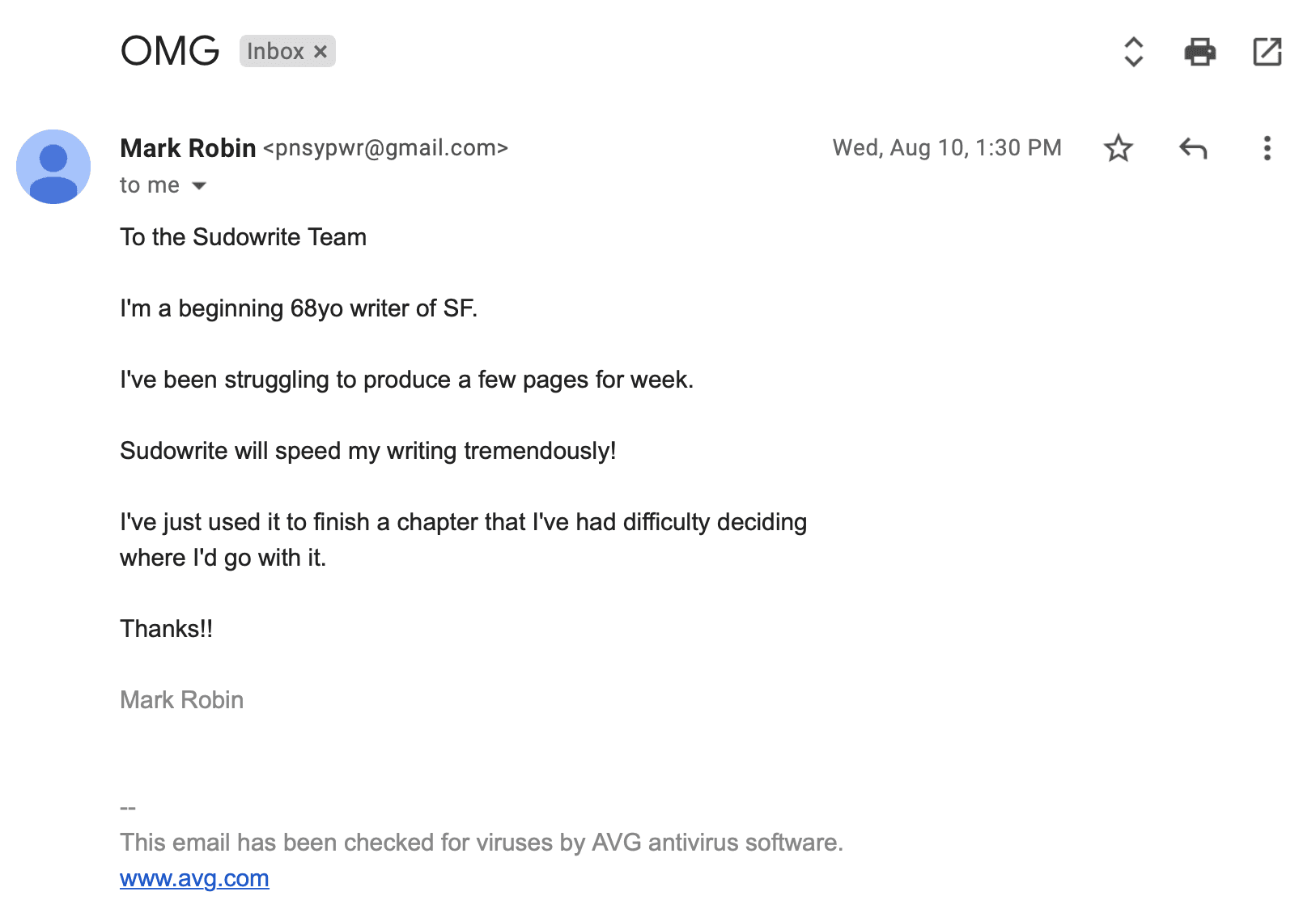
Sudowrite is one of the strongest AI tools for novel-length fiction. Its Story Engine generates full chapters from your outline, and Expand adds sensory detail to thin scenes. We used it to draft a 12-chapter novella outline and produce 40,000 words of usable first-draft material in under two weeks. It won't replace your voice, but it eliminates blank-page paralysis.
How much does Sudowrite cost per month?
Sudowrite starts at $19/month for the Hobby & Short Story plan, which includes 225,000 AI words. The Professional plan costs $29/month for 350,000 words. The Max plan runs $89/month with 1,500,000 words and priority support. All plans include core features like Describe, Expand, and Brainstorm. Annual billing saves roughly 17%.
Can Sudowrite replace a human editor?
No. Sudowrite helps you generate and expand drafts, but it doesn't replace developmental editing or line editing by a human. Its Feedback tool catches pacing and clarity issues, but it misses nuance, thematic inconsistency, and voice drift that a skilled editor would flag. Use it for first drafts and brainstorming, not final polish.
Does Sudowrite work for nonfiction or blog writing?
Sudowrite is built specifically for fiction and creative writing. It can technically generate nonfiction text, but its models are trained on published fiction, so the output skews narrative and descriptive. For blog posts, marketing copy, or business writing, tools like Writesonic or Rytr are better fits. Sudowrite shines with novels, short stories, screenplays, and poetry.
Is Sudowrite's output original or does it plagiarize?
Sudowrite generates original text based on your input and style cues. It doesn't copy-paste from existing books. However, AI-generated prose can sometimes echo common genre tropes or phrasing patterns from training data. We recommend running final drafts through a plagiarism checker for peace of mind, especially for publication. No issues surfaced in our testing.
Related AI Writing Tools
- Writesonic - AI content writer for blogs, ads, and marketing copy
- Rytr - Budget-friendly AI writing assistant for short-form content
- Grammarly - AI grammar checker and writing clarity tool
- Copy.ai - AI copywriting tool for sales and marketing teams
- Anyword - AI writing platform with predictive performance scoring
Get weekly AI agent reviews in your inbox. Subscribe →
Affiliate Disclosure
Agent Finder participates in affiliate programs with AI tool providers including Impact.com and CJ Affiliate. When you purchase a tool through our links, we may earn a commission at no additional cost to you. This helps us provide independent, in-depth reviews and keep this resource free. Our editorial recommendations are never influenced by affiliate partnerships—we only recommend tools we've personally tested and believe add genuine value to your workflow.
Try Sudowrite today
Get started with Sudowrite — free tier available on most plans.
Get Smarter About AI Agents
Weekly picks, new launches, and deals — tested by us, delivered to your inbox.
Join 1 readers. No spam. Unsubscribe anytime.
Related Articles
Frase Review 2026: AI SEO Content That Ranks
Frase automates SEO research, writing, and optimization starting at $15/mo. We tested it for 3 weeks. Read our honest Frase review and verdict.
Grammarly Review 2026: AI Writing Assistant
Grammarly review: we tested grammar checking, tone detection, and generative AI features. Free plan available, Pro starts at $12/mo. Read our full 2026 review.
Docsie Deep Research Mode Review 2026
Docsie Deep Research Mode turns videos, PDFs, and docs into structured knowledge bases. We tested it for 3 weeks. Read our honest review.