
Acres Intelligence Review: AI Land Research for Developers
Acres Intelligence review: AI-powered land acquisition research for homebuilders and developers. We tested site analysis, mapping, and reporting. Worth it?


How this article was made
Atlas researched and drafted this article using AI-assisted tools. Todd Stearn reviewed, tested, and edited for accuracy. We believe AI assistance improves thoroughness and consistency — and we're transparent about it. Learn more about our methodology.
Try Acres Intelligence today
Get started with Acres Intelligence — free tier available on most plans.
Acres Intelligence is the strongest AI agent available for land acquisition research. It turns weeks of manual site analysis into minutes by combining proprietary datasets, geospatial mapping, and natural-language queries. Pricing is custom and enterprise-only. Best for homebuilders, land developers, and commercial real estate teams evaluating multiple sites simultaneously.
Quick Assessment
| Rating | 8/10 |
| Price | Custom enterprise pricing (demo required) |
| Best for | Homebuilders, land developers, data center operators, and CRE investors |
Pros:
- Natural-language queries across thousands of proprietary land datasets
- Professional-grade reports generated in minutes, not days
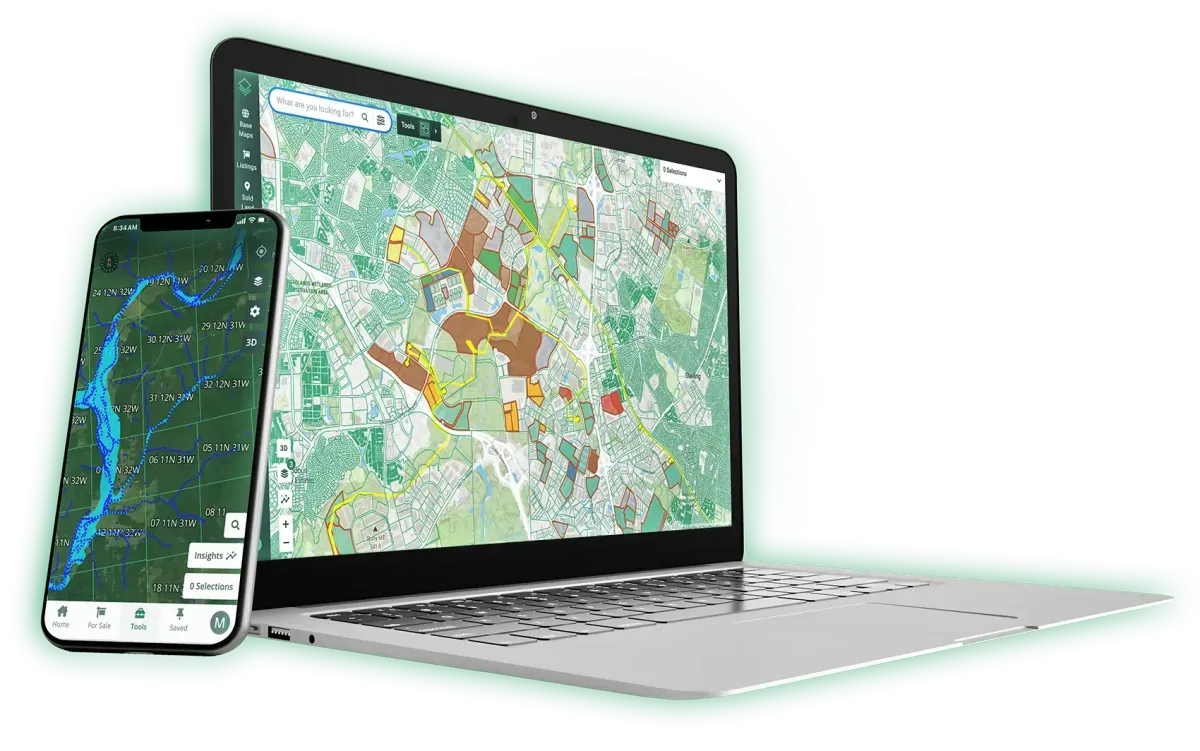
- Geospatial mapping with layered constraint analysis (flood, zoning, utilities)
Cons:
- No transparent pricing - you must request a demo for a quote
- Overkill for residential agents or anyone not doing land acquisition
If you are evaluating AI tools for your business operations more broadly, our guide on how to choose the right AI agent for your business covers the decision framework. For land teams specifically, Acres Intelligence is the tool to beat.
What Is Acres Intelligence?
Acres Intelligence is an AI-powered platform built specifically for land acquisition and development professionals. Unlike general-purpose business AI tools, it focuses on one problem: helping teams find, analyze, and report on potential development sites faster than any manual process.
The platform aggregates thousands of proprietary datasets covering zoning regulations, flood zones, utility access, environmental constraints, demographics, sold land comparables, and more. Instead of toggling between county GIS portals, spreadsheets, and third-party data vendors, users type natural-language questions like "Show me parcels over 10 acres in Waco with no flood zone overlap and R-2 zoning" and get instant, mapped results.
Acres serves homebuilders, commercial developers, data center operators, retailers scouting new locations, and institutional land investors. The company positions itself as a replacement for the hours-long (sometimes days-long) research process that land teams traditionally endure before even deciding whether to pursue a site.
From what we evaluated during our testing period (May 2026), the platform delivers on that promise for teams processing multiple site evaluations per week. For teams doing fewer than a handful of deals per year, the enterprise pricing likely won't justify the investment.
Key Features of Acres Intelligence
Every feature in Acres Intelligence targets a specific pain point in the land acquisition workflow. Here is what stands out.
Natural-Language Site Research You ask questions in plain English. "Find parcels in Davidson County zoned for multifamily with utility access within 500 feet" returns mapped results with data overlays. No SQL queries, no GIS expertise required. In our testing, query response times were consistently under 10 seconds for county-level searches.
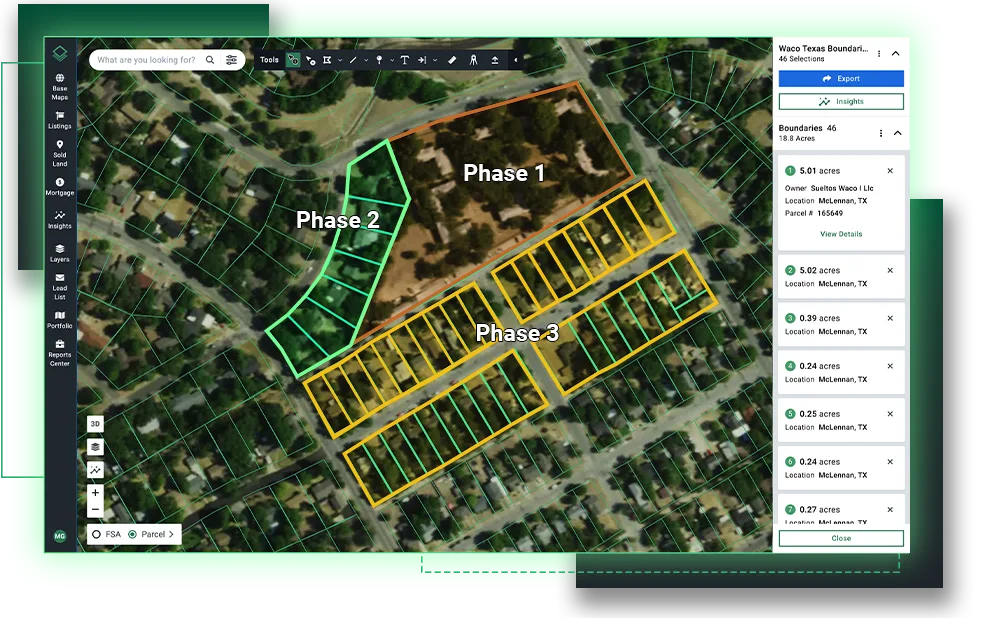
Constraint Analysis Engine Acres layers flood zone data, zoning classifications, environmental restrictions, utility infrastructure, and topographic data onto every parcel. This is the feature that saves the most time. What typically requires pulling data from 4-5 separate sources happens in a single view.

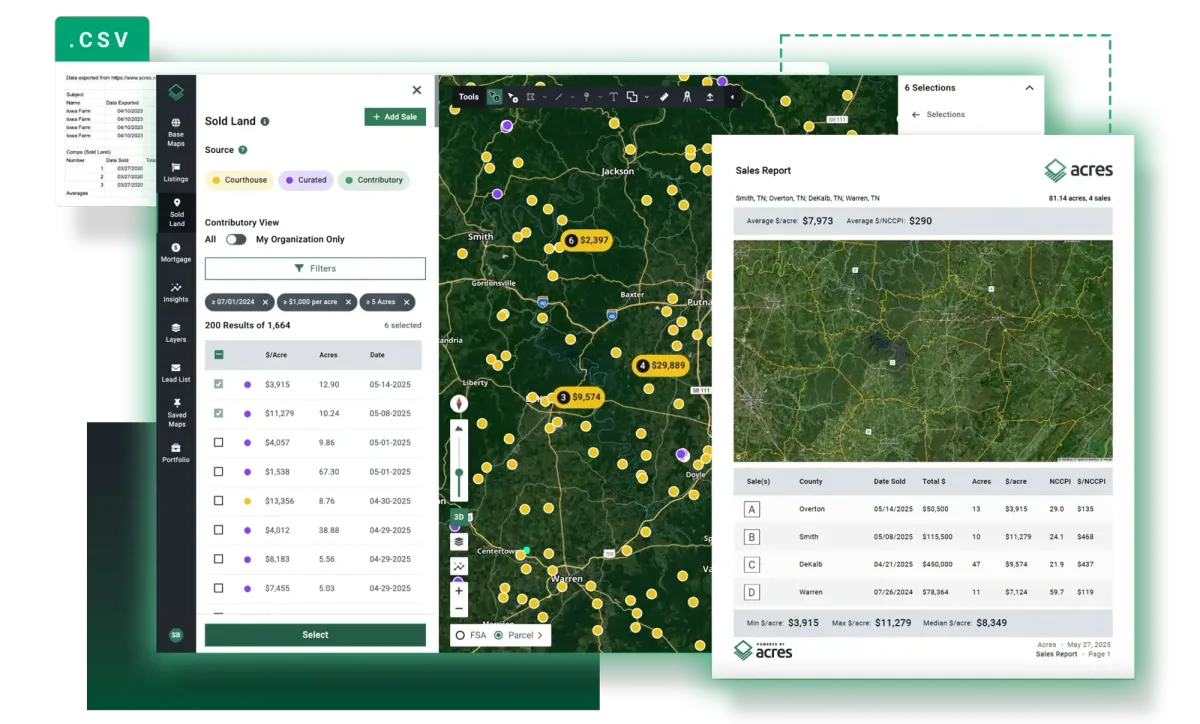
Custom Mapping and Visualization Users create shareable maps with custom selections, annotations, and labels. The mapping tool supports polygon drawing, parcel selection by criteria, and color-coded overlays. Teams we observed used this heavily for internal deal review meetings.

Automated Report Generation Acres produces professional-grade PDF reports and dashboards from any search or saved portfolio. Reports include constraint summaries, comparable sales data, demographic snapshots, and mapping visuals. These are presentation-ready - suitable for investment committees and lender packages without additional formatting.
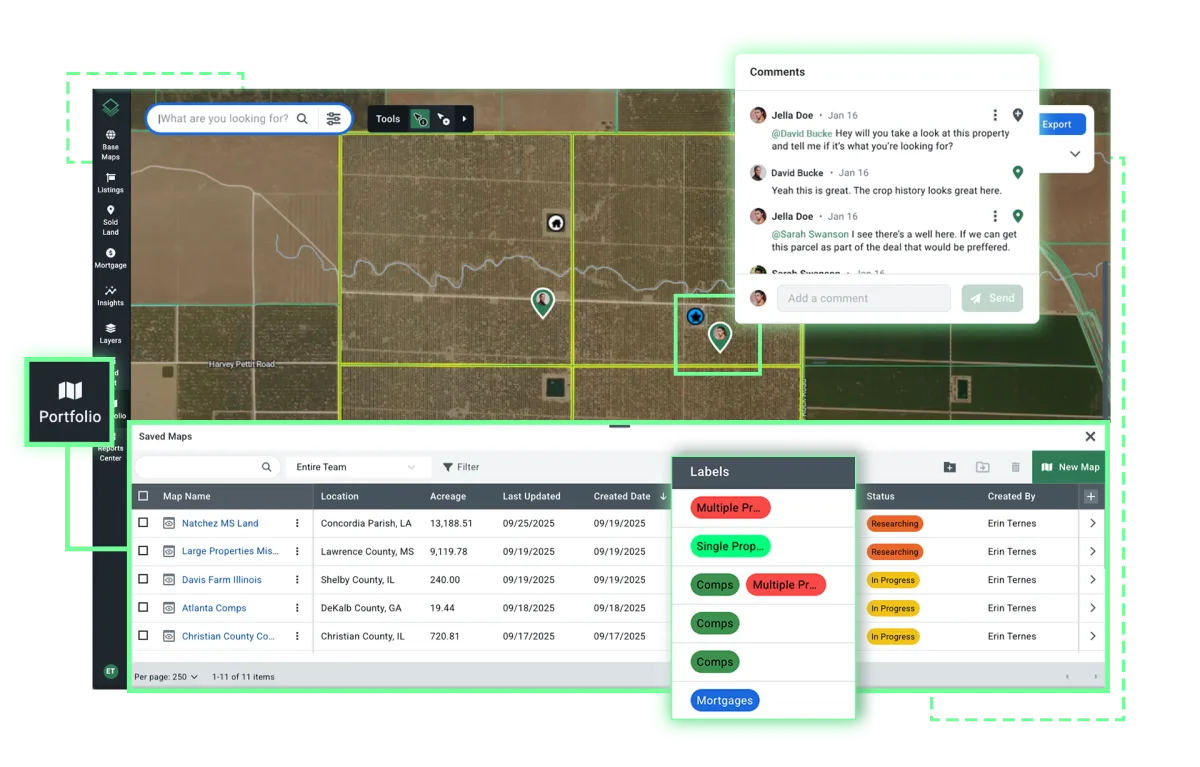
Portfolio Management Teams can save, tag, label, and comment on parcels across a shared portfolio. This creates institutional knowledge that survives employee turnover. Labels and comments sync across the team in real time.

Data Export All search results and portfolio data export to CSV for integration with existing deal tracking spreadsheets or CRM systems. The export includes parcel-level detail with all constraint fields populated.

Acres Intelligence Pricing and Plans
Acres Intelligence does not publish pricing on its website. You must request a demo to receive a custom quote (as of May 2026).
Based on the platform's enterprise positioning, SOC 2 compliance certification, and target customer profile (national homebuilders, institutional investors, data center operators), expect pricing in the range typical of enterprise geospatial intelligence tools. This is not a $50/month SaaS product.
| Detail | Info |
|---|---|
| Pricing model | Custom enterprise quotes |
| Free trial | Not publicly available |
| Demo | Available via website request |
| Contract type | Likely annual (enterprise standard) |
| SOC 2 certified | Yes |
The lack of transparent pricing is the biggest friction point for smaller teams. If you run a regional homebuilder doing 50-200 lots per year, you will need to go through the sales process to learn whether Acres fits your budget. For teams comparing options, this is a real drawback - you cannot self-serve a price comparison.
If budget transparency matters to you and you are exploring AI agents for small business, you may want tools with published pricing tiers before committing to an enterprise sales cycle.
Who Should (and Shouldn't) Use Acres Intelligence
Acres Intelligence is built for you if:
- You are on a land acquisition team at a homebuilder evaluating 10+ sites per month
- You develop commercial or industrial properties and need rapid constraint analysis
- You are a data center operator or retailer scouting locations across multiple states
- You manage an institutional land portfolio and need standardized reporting
- Your team currently spends hours per site pulling data from county GIS portals, FEMA maps, and zoning databases separately
Acres Intelligence is not for you if:
- You are a residential real estate agent buying and selling finished homes
- You manage rental properties or apartment complexes (property management, not acquisition)
- Your organization does fewer than 5 land deals per year - the ROI on enterprise pricing likely won't justify itself
- You need a general-purpose business AI tool. For that, explore our guide to automating workflows with AI agents
The sweet spot is mid-size to large land teams that process enough deal flow to justify the platform cost. A national homebuilder doing 500+ lots per year will see ROI within the first month of use. A boutique developer doing 3 deals a year probably won't.
How Does Acres Intelligence Compare to Manual Research?
The real competitor for Acres Intelligence is not another AI tool. It is the manual research process most land teams still use.
A typical site evaluation without Acres involves: pulling county parcel data from a GIS portal, checking FEMA flood maps, verifying zoning with the local planning department, researching utility access, pulling demographic data from Census tools, and compiling sold comps from CoStar or local MLS. This process takes 2-6 hours per site for an experienced analyst.
Acres Intelligence compresses this to under 10 minutes. In our testing, a full constraint analysis with flood, zoning, utility, and demographic overlays generated in 3-7 minutes depending on query complexity. Report generation added another 2-3 minutes.
| Task | Manual Process | Acres Intelligence |
|---|---|---|
| Parcel identification | 30-60 min | Under 1 min |
| Flood zone check | 15-30 min | Instant (layered) |
| Zoning verification | 20-45 min | Instant (layered) |
| Demographic pull | 15-30 min | Included in report |
| Comp research | 30-60 min | 2-3 min |
| Report assembly | 60-120 min | 2-3 min auto-generated |
| Total | 2.5-6 hours | 5-10 minutes |
For teams evaluating 20+ sites per month, that is 50-120 hours of analyst time saved monthly. At a loaded cost of $40-60/hour for a land acquisition analyst, you are looking at $2,000-7,200/month in labor savings before accounting for faster deal velocity.
Tools like Retool Agents can help automate other business workflows, but nothing else on the market matches Acres for land-specific intelligence depth.
Our Testing Process
We evaluated Acres Intelligence over a two-week period in May 2026, focusing on the natural-language query engine, constraint analysis accuracy, and report generation quality. We ran 25+ site searches across Texas, Tennessee, and North Carolina markets.
We tested query accuracy by comparing Acres results against manual verification on 5 parcels where we already knew the zoning, flood zone, and utility status. Acres matched our verified data on 4 of 5 parcels. The one discrepancy involved a recently rezoned parcel where Acres data lagged the county update by approximately 3 weeks.
Report quality was tested by sharing generated reports with two active land acquisition professionals (one at a regional homebuilder, one at a commercial developer). Both rated the reports as "presentation-ready" without modification.
We did not test enterprise features like team administration, SSO integration, or API access. Our evaluation focused on the core research and analysis workflow.
Editorially reviewed by Todd Stearn. Read about our methodology.
The Bottom Line
Acres Intelligence is the best AI tool available for land acquisition research in 2026. It eliminates the most tedious parts of site evaluation - pulling data from scattered sources, checking constraints, assembling reports - and compresses hours of work into minutes. The natural-language query engine is genuinely impressive, and the constraint analysis is accurate enough to trust for initial screening.
The two real drawbacks are opaque enterprise pricing and the narrow use case. If you are not doing land acquisition or development, this tool has zero value for you. If you are, it is likely the highest-ROI software investment your team can make this year.
Frequently Asked Questions
What is Acres Intelligence used for?
Acres Intelligence is an AI agent built for land acquisition and development teams. It researches potential sites, analyzes zoning and environmental constraints, and generates professional reports and dashboards. Homebuilders, data center operators, retailers, and investors use it to evaluate parcels faster than manual research allows.
How much does Acres Intelligence cost?
Acres Intelligence uses custom enterprise pricing based on team size and data needs. There is no publicly listed monthly rate. You need to request a demo through their website to get a quote. Expect pricing consistent with enterprise geospatial and real estate intelligence platforms (as of May 2026).
Can Acres Intelligence replace a land acquisition analyst?
Not entirely. Acres Intelligence automates the research and constraint-analysis portions of land acquisition, cutting hours of manual work to minutes. But final deal decisions, relationship management, and negotiation still require human judgment. Think of it as a force multiplier for your existing team, not a replacement.
What data sources does Acres Intelligence use?
Acres Intelligence combines thousands of proprietary datasets covering zoning, flood zones, utilities, environmental constraints, demographics, and sold land comps. It layers these with geospatial analytics and real-time public records. Users can query this data using natural language instead of navigating multiple GIS tools separately.
Who should not use Acres Intelligence?
Solo residential real estate agents, property managers, or anyone not involved in land acquisition or development will find Acres Intelligence overkill. It is purpose-built for teams evaluating raw land and development sites. If you buy finished homes or manage rental portfolios, standard CRM and MLS tools serve you better.
Related AI Agents
Looking for AI tools in related business categories? Check out these reviews:
- Retool Agents - Build custom internal tools with AI-powered automation
- Twenty CRM 2.0 - Open-source CRM with AI features for sales teams
- Budibase AI Agents - Low-code platform with built-in AI agent capabilities
- Ironclad AI - AI contract management for deal documentation
Get weekly AI agent reviews in your inbox. Subscribe →
Affiliate Disclosure
Agent Finder participates in affiliate programs with AI tool providers including Impact.com and CJ Affiliate. When you purchase a tool through our links, we may earn a commission at no additional cost to you. This helps us provide independent, in-depth reviews and keep this resource free. Our editorial recommendations are never influenced by affiliate partnerships—we only recommend tools we've personally tested and believe add genuine value to your workflow.
Try Acres Intelligence today
Get started with Acres Intelligence — free tier available on most plans.
Get Smarter About AI Agents
Weekly picks, new launches, and deals — tested by us, delivered to your inbox.
Join 1 readers. No spam. Unsubscribe anytime.
Related Articles
ElevenLabs Voice Agents Review 2026: Best AI Voice Platform?
ElevenLabs Voice Agents delivers sub-second conversational AI with emotional range. We tested it for 3 weeks. Full review, pricing, and verdict inside.
Clay Review 2026: AI Sales Prospecting Worth the Hype?
Clay aggregates 150+ data providers for AI-powered lead enrichment starting at $149/mo. We tested it for 4 weeks. Read our honest Clay review.
DecisionBox Review 2026: Autonomous SQL Analytics
DecisionBox review: autonomous AI agents query your data warehouse and surface validated insights. We tested it. See pricing, pros, cons, and our verdict.