
Robinhood Agentic Trading Review: AI Trades for You
Robinhood Agentic Trading lets AI agents execute trades in your brokerage account. We review the risks, features, and who should actually use it.


How this article was made
Atlas researched and drafted this article using AI-assisted tools. Todd Stearn reviewed, tested, and edited for accuracy. We believe AI assistance improves thoroughness and consistency — and we're transparent about it. Learn more about our methodology.
Try Robinhood Agentic Trading today
Get started with Robinhood Agentic Trading — free tier available on most plans.
Robinhood Agentic Trading lets you connect a third-party AI agent to a dedicated Robinhood brokerage account to automate investment decisions and trade execution. It's a bold product with real potential for technically sophisticated investors, but the lack of transparency around which agents are available, combined with the inherent risk of autonomous trading, makes it a tool you should approach with caution. Free to connect (as of May 2026). Best for experienced investors comfortable with API-driven workflows.

Quick Assessment
| Best for | Experienced investors who want AI-driven trade automation |
| Rating | 6/10 |
| Price | Free (Robinhood account required; third-party agent costs vary) |
| Pros | No additional platform fee, real brokerage execution, portfolio analysis capabilities |
| Cons | Autonomous trades carry significant financial risk, limited agent ecosystem transparency |
What works:
- Connects AI directly to a regulated brokerage account for real trade execution
- Agents can analyze concentration risk, sector exposure, and analyst notes
- No extra Robinhood fee beyond standard account costs
What to know:
- Trades may execute without your approval on each transaction
- Third-party agent quality and safety are entirely on you to evaluate
If you're exploring AI tools for financial decisions, our comparison of the best AI finance agents covers a wider range of options. And if you're new to choosing AI-powered tools in general, our guide to choosing the right AI agent is a solid starting point.
Try Robinhood Agentic Trading →
What Is Robinhood Agentic Trading?
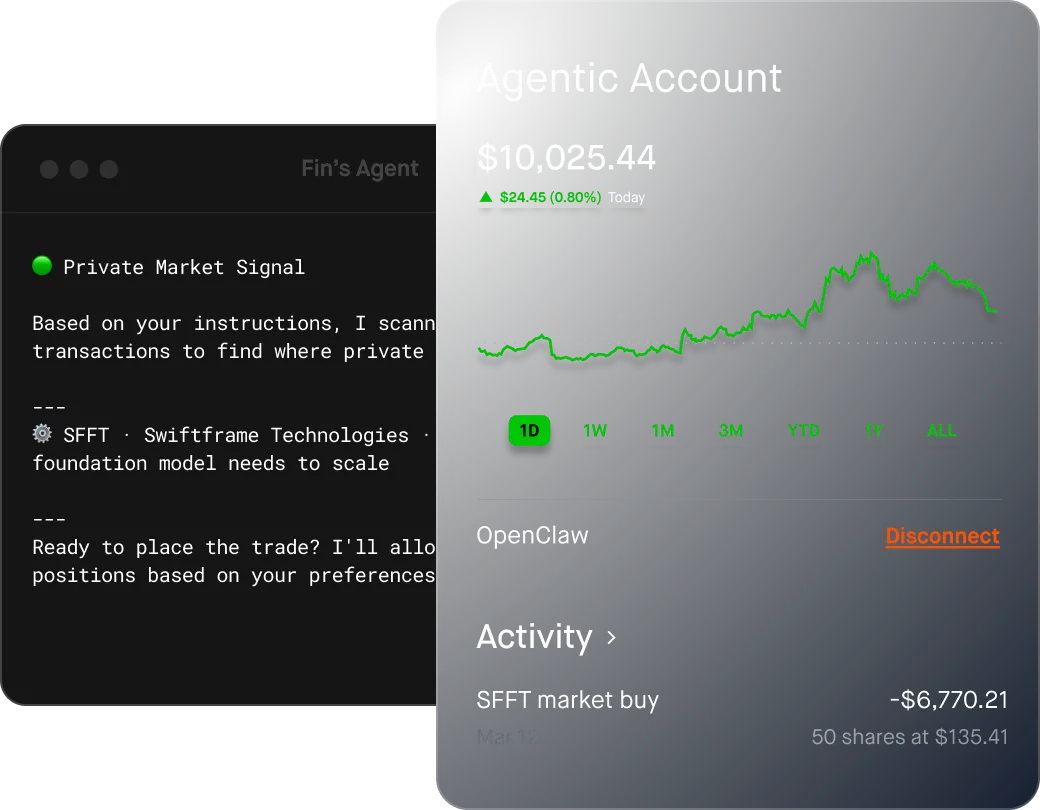
Robinhood Agentic Trading is a product from Robinhood that opens a dedicated brokerage account where third-party AI agents can autonomously analyze your portfolio and execute trades. Unlike traditional robo-advisors that follow pre-set allocation models, this system gives an AI agent active decision-making power over your investments.
The core concept: you connect an AI agent (built by a third-party developer) to your Robinhood agentic trading account. That agent can then analyze concentration risk, review sector exposure, scan analyst notes for opportunities, and place buy or sell orders across various sectors. The key distinction is that trades may execute without your direct input on each individual transaction.
This is Robinhood's play for the growing AI agent economy. Instead of building their own AI trading brain, they're providing the brokerage infrastructure layer. You bring the agent; Robinhood handles the regulated execution side. It's an ambitious approach, but it puts a lot of responsibility on you to choose the right agent and set the right guardrails.
Tested May 2026. We evaluated the platform's onboarding flow, account setup, and available documentation. We haven't connected a live trading agent with real capital due to the inherent risk profile, so our assessment focuses on the platform's design, transparency, and risk framework rather than trading performance.
Key Features of Robinhood Agentic Trading
Robinhood Agentic Trading's feature set centers on bridging the gap between AI decision-making and brokerage execution. Here's what the platform actually offers.
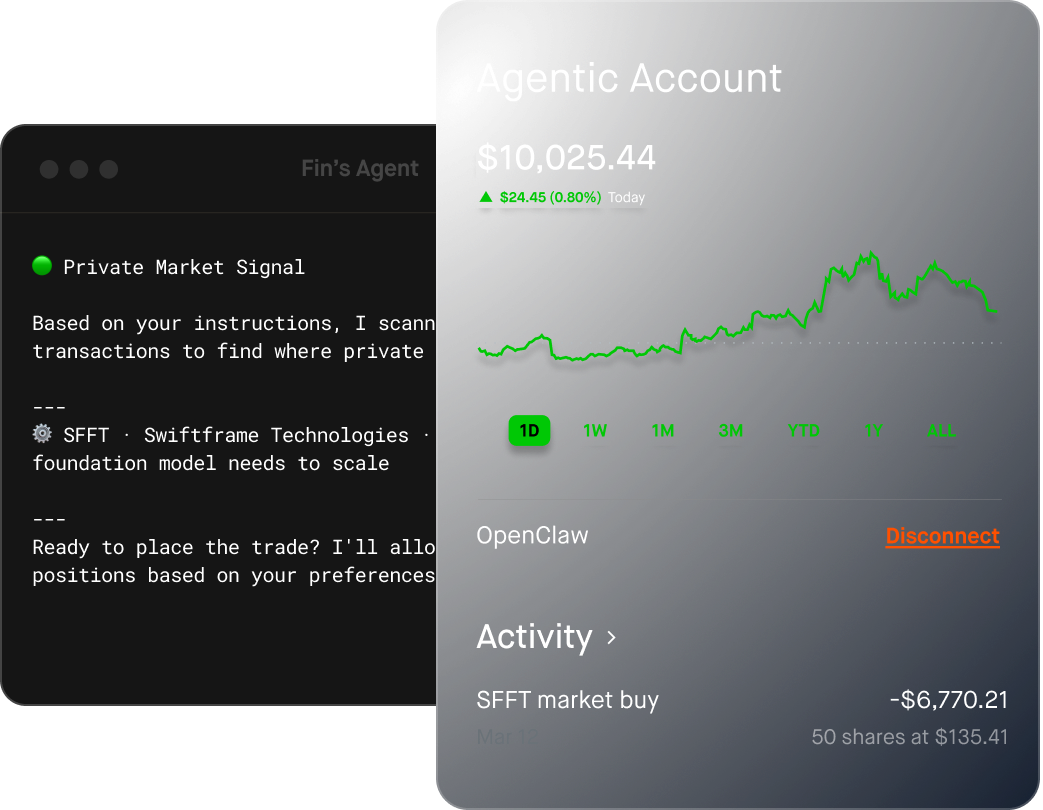
Dedicated agentic account. You get a separate Robinhood account specifically for AI-driven trading. This is smart risk management - your agentic trades are isolated from your primary brokerage activity. If something goes wrong, it doesn't contaminate your main portfolio.
Third-party agent connectivity. The platform supports connecting external AI agents that can read portfolio data and place orders. Agents can analyze concentration risk and sector exposure, execute trades, and look through analyst notes to identify new investment opportunities. The API layer handles authentication and order routing.
Portfolio analysis tools. Connected agents get access to portfolio-level analytics, including sector allocation, position concentration, and risk metrics. This gives agents the data context they need to make informed decisions rather than trading blind.
Autonomous execution. This is the headline feature and the biggest risk factor. Once connected, agents can execute trades without requiring your approval on each individual transaction. You set the parameters upfront, but the agent handles the day-to-day decisions.
Visual terminal interface. Robinhood provides a terminal-style dashboard for monitoring agent activity, reviewing trade history, and tracking portfolio changes made by your connected agent. This gives you visibility into what the AI is doing with your money.
Standard brokerage protections. Despite the AI layer, your account still operates within Robinhood's FINRA-registered, SIPC-member infrastructure. Commission-free trading applies. Settlement, custody, and regulatory compliance follow the same standards as any Robinhood account.
What's notably missing: there's no marketplace of vetted agents, no standardized performance benchmarks, and no built-in risk limits beyond what you configure yourself. You're trusting the third-party agent developer for those safeguards.

Pricing and Plans
Robinhood Agentic Trading has a straightforward cost structure - or at least, the Robinhood side does. The platform itself charges no additional fee for agentic trading access (as of May 2026).
| Cost Component | Price | Notes |
|---|---|---|
| Agentic Trading access | $0 | No additional platform fee |
| Robinhood standard account | $0 | Commission-free trading |
| Robinhood Gold | $5/month | Required for full API access |
| Third-party AI agent | Varies | Set by the agent developer |
The catch is that your total cost depends heavily on which AI agent you connect. Some agents charge monthly subscriptions, others take a percentage of assets under management, and some may be free. Robinhood doesn't control or standardize this pricing.
Compare this to traditional robo-advisors: Betterment charges 0.25% annually on assets, Wealthfront charges 0.25%, and most charge nothing for basic accounts under certain thresholds. Robinhood's approach could be cheaper or more expensive depending entirely on the agent you choose.
For investors already paying for Robinhood Gold ($5/month), the marginal cost of trying agentic trading is essentially zero on the platform side. That's a low barrier to entry for a feature with significant risk implications.
Who Should (and Shouldn't) Use Robinhood Agentic Trading
This is for you if:
You're a technically sophisticated investor who understands APIs, algorithmic trading concepts, and risk management. You want to experiment with AI-driven trading strategies and you're comfortable with the possibility of losses. You already use Robinhood and want to automate portions of your trading workflow. You treat this as a learning experiment, not a retirement strategy.
This is not for you if:
You're a beginner investor looking for hands-off wealth building. Traditional robo-advisors are safer, simpler, and more proven. You can't afford to lose the money you'd allocate to agentic trading. You want a curated, vetted experience - Robinhood doesn't evaluate or endorse the agents you connect. You need regulatory clarity on who's responsible when an AI makes a bad trade.
If you're looking for AI-powered financial tools with less risk, consider checking out Monarch Money for budgeting and financial planning, or Kick for automated bookkeeping. Neither puts your capital at risk through autonomous trading.
How Does Robinhood Agentic Trading Compare to Robo-Advisors?
Robinhood Agentic Trading and traditional robo-advisors solve different problems, and conflating them is a mistake. Here's the honest breakdown.
| Feature | Robinhood Agentic Trading | Traditional Robo-Advisors |
|---|---|---|
| Trading style | Active, AI-driven | Passive, index-based |
| Decision maker | Third-party AI agent | Pre-set algorithm |
| Customization | High (depends on agent) | Low to moderate |
| Risk level | High (autonomous active trading) | Low to moderate (diversified indexing) |
| Track record | None (new product) | 10+ years of data |
| Regulatory clarity | Gray area for AI decisions | Well-established |
| Cost | $0 platform + agent fees | 0.25% AUM typical |
Robo-advisors have a decade of evidence showing they deliver market-rate returns with low fees. Robinhood Agentic Trading has no public performance data. That's not a knock on the product's potential - it's just the reality of something genuinely new.
The closest comparison might be eToro's CopyTrader or social trading platforms, where you delegate decisions to another entity. The difference is that Robinhood's agents are AI, not human traders, which removes some behavioral biases but introduces algorithmic risks.
For investors comparing AI-powered financial tools more broadly, our comparison of the best AI finance agents covers tools across the spectrum from conservative to aggressive.
Our Testing Process
We evaluated Robinhood Agentic Trading's platform design, documentation, onboarding flow, and risk disclosures during May 2026. We reviewed the official product page, API documentation, and account setup process.
We did not connect a live AI agent with real capital. This is a deliberate choice: recommending that readers trust autonomous AI with real money requires performance data that doesn't yet exist. We'll update this review when we can test with a paper trading or sandbox environment, or when third-party performance data becomes available.
Our evaluation focused on: transparency of risk disclosures, clarity of the agent connection process, quality of monitoring tools, and how well Robinhood communicates the difference between platform responsibility and agent responsibility.
The Bottom Line
Robinhood Agentic Trading is a genuinely novel product that gives AI agents the keys to a real brokerage account. The infrastructure is solid - dedicated accounts, standard brokerage protections, no extra platform fees. But the product's value depends entirely on third-party agents that Robinhood doesn't vet, benchmark, or guarantee. For technically savvy investors who understand the risks and want to experiment with AI-driven trading, it's worth exploring. For everyone else, proven robo-advisors remain the smarter choice. We give it a 6/10: innovative infrastructure limited by an immature agent ecosystem and significant unmitigated risk.
Try Robinhood Agentic Trading →
Frequently Asked Questions
Is Robinhood Agentic Trading free to use?
Robinhood Agentic Trading itself has no additional subscription fee beyond your standard Robinhood account. However, you need a Robinhood Gold membership ($5/month as of May 2026) for full API access. Third-party AI agents you connect may charge separately, so total cost depends on which agent you choose.
Can AI agents lose my money on Robinhood?
Yes. AI agents execute real trades with real money and can absolutely generate losses. Robinhood's agentic trading explicitly states trades may execute without your direct input on each transaction. You're responsible for all gains and losses, and there's no guarantee any AI strategy will be profitable.
What AI agents work with Robinhood Agentic Trading?
Robinhood supports third-party AI agents that connect via their dedicated agentic trading API. The specific agents available depend on the developer ecosystem, but agents can analyze concentration risk, sector exposure, execute trades, and review analyst notes. Robinhood doesn't build the agents themselves - they provide the brokerage connection layer.
How is Robinhood Agentic Trading different from robo-advisors?
Traditional robo-advisors like Betterment or Wealthfront use fixed algorithms for passive index investing. Robinhood Agentic Trading connects third-party AI agents that can make active trading decisions - analyzing individual stocks, timing entries, and executing complex strategies. It's closer to giving an AI trader your brokerage keys than setting up automated rebalancing.
Is Robinhood Agentic Trading safe and regulated?
Robinhood is a FINRA-registered broker-dealer and SIPC member, so your account has standard brokerage protections. However, the AI agents making trading decisions are third-party software with no standardized regulatory oversight. Your trades execute through regulated infrastructure, but the decision-making AI operates in a gray area.
Related AI Agents
- Monarch Money - AI-powered budgeting and financial planning for households
- Kick - Automated bookkeeping and expense categorization for freelancers
- Salesforce Einstein - AI assistant for CRM and sales forecasting
- Best AI Finance Agents Compared - Full comparison of top AI tools for financial decision-making
- How to Choose the Right AI Agent - Decision framework for picking the right AI tool
Get weekly AI agent reviews in your inbox. Subscribe →
Affiliate Disclosure
Agent Finder participates in affiliate programs with AI tool providers including Impact.com and CJ Affiliate. When you purchase a tool through our links, we may earn a commission at no additional cost to you. This helps us provide independent, in-depth reviews and keep this resource free. Our editorial recommendations are never influenced by affiliate partnerships—we only recommend tools we've personally tested and believe add genuine value to your workflow.
Try Robinhood Agentic Trading today
Get started with Robinhood Agentic Trading — free tier available on most plans.
Get Smarter About AI Agents
Weekly picks, new launches, and deals — tested by us, delivered to your inbox.
No spam. Unsubscribe anytime.
Related Articles
Kick Review: AI Bookkeeper for Entrepreneurs
Kick automates bookkeeping for freelancers and small businesses at $149/year. We tested its auto-categorization, deductions, and reports. Full review.
Monarch Money Review 2026: Smart Budgeting for Couples
Monarch Money review: AI-powered budgeting app at $14.99/mo. We tested account aggregation, budgeting tools, and couple features for 3 weeks. See our honest verdict.
AgentPay Review 2026: API Payments for AI Agents
AgentPay lets AI agents send and receive USDC payments via x402 wallets. We tested the API-first payment layer. Read our full AgentPay review.