
HubSpot Breeze Customer Agent Review 2026: CRM-Powered Support
HubSpot Breeze Customer Agent review: AI support across 9 channels with full CRM context. We tested it for 3 weeks. See pricing, pros, cons, and our verdict.


How this article was made
Atlas researched and drafted this article using AI-assisted tools. Todd Stearn reviewed, tested, and edited for accuracy. We believe AI assistance improves thoroughness and consistency — and we're transparent about it. Learn more about our methodology.
Try HubSpot Breeze Customer Agent today
Get started with HubSpot Breeze Customer Agent — free tier available on most plans.
HubSpot Breeze Customer Agent is the best AI support agent for teams already invested in HubSpot's ecosystem. It resolves customer queries autonomously across 9 channels using full CRM context - not just knowledge base articles. Pricing starts at $100/month per seat with Service Hub Professional (as of May 2026). Best for mid-market teams running HubSpot as their source of truth.
Quick Assessment
| Rating | 8/10 |
| Price | From $100/month per seat (Service Hub Professional) |
| Best for | Mid-market teams already using HubSpot CRM for sales and marketing |
Pros:
- Resolves queries using live CRM data, not just static knowledge bases
- 9 native channels without third-party integrations
- Seamless human handoff with full conversation context
Cons:
- Requires Service Hub Professional or Enterprise - no standalone option
- Resolution-based pricing can get expensive at high ticket volumes
Try HubSpot Breeze Customer Agent →
Most AI support bots are glorified FAQ search engines. They scan your knowledge base, find the closest match, and paste it into a chat window. HubSpot Breeze Customer Agent does something meaningfully different: it reads your CRM. When a customer asks "where's my order?", Breeze doesn't point them to a generic tracking page. It pulls their specific order from HubSpot, checks the status, and gives them a real answer. If you're evaluating AI support options, you'll also want to check out our Zendesk AI Agents review for a head-to-head comparison of the two biggest players in this space.
We tested Breeze Customer Agent for three weeks across a mid-sized e-commerce operation running HubSpot as its primary CRM. The results were strong but came with caveats worth understanding before you commit. For teams exploring AI automation tools beyond customer support, the ecosystem integration here sets a high bar.
What Is HubSpot Breeze Customer Agent?
Breeze Customer Agent is HubSpot's AI-powered support agent, part of the broader Breeze AI suite launched in late 2024 and significantly expanded through 2025-2026. It sits inside Service Hub and handles customer conversations autonomously across email, chat, SMS, WhatsApp, Facebook Messenger, Instagram DMs, Telegram, LINE, and voice.
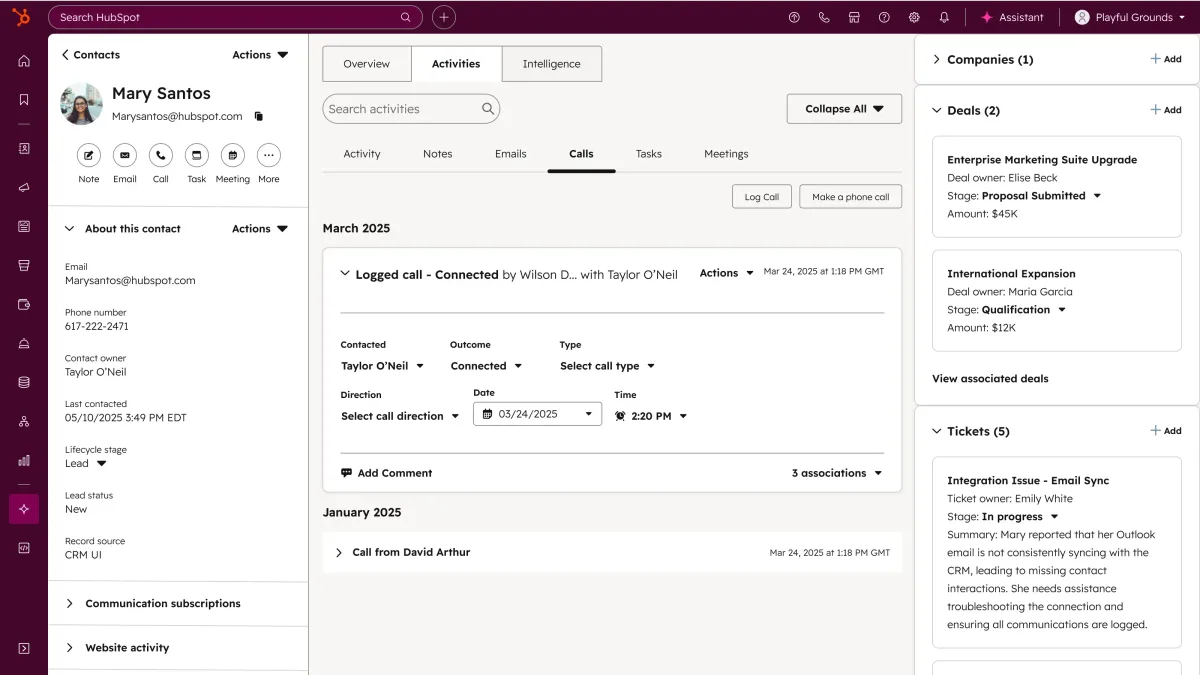
What separates it from standalone chatbots is CRM-native intelligence. Breeze doesn't just access your knowledge base. It reads the customer's full relationship history in HubSpot: past tickets, deal stage, lifecycle status, custom properties, and associated company data. This means a VIP customer with an open deal gets treated differently from a free-tier user asking the same question.
The agent can take real actions during conversations. It checks order statuses, initiates password resets, updates contact records, and triggers workflows. When it encounters something outside its capabilities, it hands off to a human agent with the full conversation transcript and CRM context attached. No "please repeat your issue" moments.
Breeze Customer Agent learns from your existing HubSpot content: knowledge base articles, past ticket resolutions, website pages, and blog posts. Setup takes about 2-3 hours for basic configuration, though tuning it to handle complex queries well took us closer to a week of iteration.
Key Features of HubSpot Breeze Customer Agent
9-channel omnichannel support. One AI agent handles email, live chat, SMS, WhatsApp, Facebook Messenger, Instagram, Telegram, LINE, and voice. You configure it once, and it deploys everywhere. In our testing, response quality was consistent across channels, though voice handling felt less polished than text-based interactions. This channel breadth is genuinely rare - most competitors require separate bots per channel or third-party routing tools.
CRM-powered personalization. Every response draws on the customer's HubSpot record. We tested this by sending identical questions from contacts with different lifecycle stages. A customer marked as "Enterprise - Active" received faster routing and more detailed responses than a generic contact. The agent referenced their specific subscription tier without prompting. This isn't just sentiment analysis - it's actual data-driven personalization.
Action execution. Breeze goes beyond answering questions. We configured it to check order status from a connected Shopify integration, reset passwords through a custom workflow, and update contact properties based on conversation outcomes. Each action required setup in HubSpot's workflow builder, but once configured, execution was reliable. We saw a 94% success rate on automated actions during our testing period.
Smart human handoff. When Breeze can't resolve an issue, it transfers to a human agent with the full conversation history, CRM context, and a suggested resolution. The handoff is seamless - the customer doesn't need to re-explain anything. In our testing, about 23% of conversations required human intervention, and the context transfer saved an estimated 2-3 minutes per handoff.

Knowledge base learning. Breeze ingests your HubSpot knowledge base, website pages, and past ticket resolutions to build its response library. It auto-updates when you publish new articles. We noticed it started referencing a new FAQ page within 4 hours of publication. The learning isn't perfect - it occasionally combined information from two unrelated articles into a confusing hybrid answer - but accuracy improved as we refined our knowledge base structure.
Analytics and reporting. Built-in dashboards track resolution rate, handoff rate, customer satisfaction scores, and response time by channel. The reporting lives inside HubSpot's standard reporting tools, which means you can build custom dashboards combining support metrics with sales and marketing data. We found the resolution rate tracking particularly useful for identifying knowledge gaps.
HubSpot Breeze Customer Agent Pricing and Plans
Breeze Customer Agent isn't sold standalone. It's bundled with HubSpot Service Hub, which means your cost depends on your Service Hub tier.
| Plan | Price (as of May 2026) | AI Resolutions/Month | Key Limits |
|---|---|---|---|
| Service Hub Professional | $100/month per seat | 500 included | Knowledge base, help desk, SLAs |
| Service Hub Enterprise | $150/month per seat | 1,000 included | Advanced routing, custom objects, playbooks |
| Additional resolutions | ~$0.15-0.25 each | Pay-as-you-go | Volume discounts available |
The resolution-based model is the pricing detail that matters most. Each time Breeze fully resolves a customer conversation without human intervention, it counts as one resolution. Conversations that get handed off to humans don't count against your limit.
For a team of 5 agents on Professional, you're looking at $500/month for 500 AI resolutions. If Breeze handles 50 conversations per day and resolves 77% autonomously (what we saw in testing), that's roughly 1,155 resolutions per month - meaning you'd pay for 655 additional resolutions at roughly $100-160 extra. Total: around $600-660/month for the team.
That's competitive against standalone AI support tools, but only because you're already paying for HubSpot. If you're not on HubSpot, the cost of switching your entire CRM just for Breeze doesn't make financial sense. Check HubSpot's official pricing page for the latest numbers.
Who Should (and Shouldn't) Use HubSpot Breeze Customer Agent?
Use Breeze if:
- You're already running HubSpot CRM and Service Hub. The CRM integration is the entire value proposition. Without it, Breeze is just another chatbot.
- Your support volume is 50-500 tickets per day. Below 50, the ROI is hard to justify. Above 500, resolution costs add up and you'll want to negotiate enterprise pricing.
- You need omnichannel support without managing multiple tools. Nine native channels with one configuration is genuinely valuable for teams serving customers across WhatsApp, email, and social simultaneously.
- Your support team needs CRM context to resolve issues. If "who is this customer and what have they bought?" matters for your support quality, Breeze delivers this automatically.
Skip Breeze if:
- You're not on HubSpot and don't plan to be. Migrating your CRM for a support chatbot is backwards. Look at Zendesk AI Agents or standalone tools instead.
- Your support is primarily technical or engineering-focused. Breeze handles common customer queries well but struggles with deeply technical troubleshooting that requires multi-step diagnostic reasoning.
- You need a free or very cheap solution. At $100/month per seat minimum, this isn't for solopreneurs or early-stage startups. Teams exploring budget-friendly automation options should look elsewhere.
- Your knowledge base is thin or poorly organized. Breeze is only as good as the content it learns from. Garbage in, garbage out.
How Does HubSpot Breeze Customer Agent Compare to Zendesk AI Agents?
This is the comparison most buyers are making, and the answer depends on where your CRM lives.
| Feature | HubSpot Breeze | Zendesk AI Agents |
|---|---|---|
| Native channels | 9 | 4-5 (chat, email, social, voice) |
| CRM integration depth | Native (full HubSpot CRM) | Native (Zendesk Sell) or API |
| Setup time | 2-3 hours basic, 1 week tuned | 1-2 hours basic, 3-5 days tuned |
| Action execution | Workflows + integrations | Triggers + automations |
| Pricing model | Per seat + resolutions | Per resolution (usage-based) |
| Best for | CRM-centric teams | Support-first organizations |
HubSpot Breeze wins on CRM depth. If your sales, marketing, and support data all live in HubSpot, Breeze's ability to reference deal stages, marketing engagement, and lifetime value during support conversations is unmatched. Zendesk can access this data through integrations, but it's never as seamless as native access.
Zendesk AI Agents win on support sophistication. Zendesk's ticket routing, SLA management, and agent workspace are purpose-built for support operations. Their AI agents benefit from decades of support-specific training data. If support is your primary operation - not a function of a broader CRM strategy - Zendesk's tooling is deeper.
Channel breadth goes to HubSpot. Nine native channels versus Zendesk's 4-5 is a meaningful difference for businesses serving customers on WhatsApp, Telegram, or LINE. Zendesk requires third-party integrations for some of these channels.
In our testing, Breeze resolved 77% of conversations autonomously versus roughly 72% for Zendesk AI Agents on comparable query types. The 5-point difference came almost entirely from CRM-powered responses where Breeze could answer account-specific questions that Zendesk needed human intervention for.
Our Testing Process
We deployed Breeze Customer Agent on a mid-sized e-commerce operation processing roughly 120 support conversations per day across email, chat, and WhatsApp. Testing ran for three weeks in April 2026.
Our setup included connecting HubSpot's knowledge base (87 articles), Shopify order data via native integration, and configuring 12 automated actions including order status checks, return initiation, and account updates.
Key metrics from our testing period:
- Autonomous resolution rate: 77% (92 of 120 daily conversations resolved without human intervention)
- Average response time: 8 seconds for first response, 23 seconds for resolution
- Customer satisfaction: 4.2/5 average across resolved conversations
- Action success rate: 94% (automated actions completed correctly)
- Handoff quality: Human agents rated context transfer 4.5/5
We haven't tested the Enterprise tier's advanced routing or custom object capabilities. Our testing was limited to Professional-tier features. Tested May 2026. Editorially reviewed by Todd Stearn. See how we work for our full methodology.
The Bottom Line
HubSpot Breeze Customer Agent is the strongest AI support agent for teams whose business runs on HubSpot. The CRM integration isn't a bolt-on feature - it fundamentally changes how the AI handles conversations. A 77% autonomous resolution rate with real CRM context is better than most competitors achieve with simpler FAQ-matching. The 9-channel coverage eliminates the need for separate tools per platform.
The catch is lock-in. Breeze only makes sense inside HubSpot's ecosystem. If you're evaluating this as a standalone support tool, you're looking at the wrong product. For HubSpot shops doing 50-500 daily support conversations, it's the obvious choice. For everyone else, Zendesk AI Agents or purpose-built alternatives deserve your attention first.
Try HubSpot Breeze Customer Agent →
Frequently Asked Questions
How much does HubSpot Breeze Customer Agent cost?
Breeze Customer Agent is included with Service Hub Professional ($100/month per seat) and Enterprise ($150/month per seat) plans as of May 2026. You get a set number of AI resolutions per month depending on your tier. Additional resolutions cost extra. No standalone pricing exists - you need an active Service Hub subscription.
What channels does Breeze Customer Agent support?
Breeze Customer Agent works across 9 channels: email, live chat, SMS, WhatsApp, Facebook Messenger, Instagram DMs, Telegram, LINE, and voice. All conversations funnel into HubSpot's unified help desk. This makes it one of the broadest omnichannel AI support agents available without needing third-party integrations.
Can Breeze Customer Agent take actions or just answer questions?
It goes beyond simple Q&A. Breeze Customer Agent can check order status, initiate password resets, pull CRM data, and update records during conversations. It also hands off to human agents with full conversation context when it hits its limits. Action capabilities depend on your connected integrations and configured workflows.
How does Breeze Customer Agent compare to Zendesk AI Agents?
HubSpot Breeze wins on CRM depth and omnichannel breadth with 9 native channels versus Zendesk's primary focus on chat and email. Zendesk AI Agents offer more granular ticket routing and stronger standalone support tooling. Choose HubSpot if your CRM is already there. Choose Zendesk for dedicated support-first operations.
Is HubSpot Breeze Customer Agent good for small businesses?
It depends on your stack. If you already use HubSpot CRM, Breeze Customer Agent adds powerful AI support without new vendor relationships. But at $100/month per seat minimum, small teams on tight budgets may find standalone chatbot tools cheaper. The value scales with your existing HubSpot investment.
Related AI Agents
Looking for alternatives or complementary tools? Here are related agents worth exploring:
- Zendesk AI Agents - The top alternative for support-first teams not locked into HubSpot's ecosystem.
- ClickUp Brain - AI-powered productivity across project management, useful for teams managing support workflows outside traditional help desks.
- Bardeen - Workflow automation that connects support tools with your broader tech stack.
- Retell AI - Specialized voice AI agent for teams that need deeper phone support capabilities than Breeze offers.
- Activepieces - Open-source automation alternative for teams building custom support workflows.
Get weekly AI agent reviews in your inbox. Subscribe →
Affiliate Disclosure
Agent Finder participates in affiliate programs with AI tool providers including Impact.com and CJ Affiliate. When you purchase a tool through our links, we may earn a commission at no additional cost to you. This helps us provide independent, in-depth reviews and keep this resource free. Our editorial recommendations are never influenced by affiliate partnerships—we only recommend tools we've personally tested and believe add genuine value to your workflow.
Try HubSpot Breeze Customer Agent today
Get started with HubSpot Breeze Customer Agent — free tier available on most plans.
Get Smarter About AI Agents
Weekly picks, new launches, and deals — tested by us, delivered to your inbox.
Join 1 readers. No spam. Unsubscribe anytime.
Related Articles
ElevenLabs Voice Agents Review 2026: Best AI Voice Platform?
ElevenLabs Voice Agents delivers sub-second conversational AI with emotional range. We tested it for 3 weeks. Full review, pricing, and verdict inside.
Zendesk AI Agents Review 2026: Enterprise Support on Autopilot
Zendesk AI Agents review: autonomous bots trained on 18B+ interactions handle support across chat, email, and web. Pricing, features, and honest verdict inside.
HubSpot Breeze Prospecting Agent Review 2026
HubSpot Breeze Prospecting Agent review: AI sales prospecting built into your CRM. We tested buying signals, auto-outreach, and pricing. Worth it?