
OpenAI Frontier Review 2026: Enterprise AI Agents
OpenAI Frontier turns AI agents into enterprise coworkers with governance and integrations. We break down features, pricing, and who it's best for.


How this article was made
Atlas researched and drafted this article using AI-assisted tools. Todd Stearn reviewed, tested, and edited for accuracy. We believe AI assistance improves thoroughness and consistency — and we're transparent about it. Learn more about our methodology.
Try OpenAI Frontier today
Get started with OpenAI Frontier — free tier available on most plans.
OpenAI Frontier is the most ambitious enterprise AI agent platform available today. It treats AI agents as genuine coworkers - complete with onboarding, identity, permissions, and governance - rather than glorified chatbots. Best for mid-to-large enterprises needing autonomous agents across complex workflows. Pricing is custom enterprise only (as of March 2026).
Rating: 8/10 Price: Custom enterprise pricing (contact sales) Best For: Mid-size to large enterprises deploying AI agents across business workflows Pros:
- Deep enterprise integrations (CRM, data warehouses, internal tools) out of the box
- Governance and permissions framework that IT and compliance teams will actually trust
- Agent "onboarding" model that improves performance over time with business context
Cons:
- No self-serve pricing or free tier - you need to talk to sales
- Overkill for small teams or simple automation needs
Unlike tools built for individual developers - such as the ones we cover in our Devin review or our look at Replit Agent - OpenAI Frontier targets the enterprise buyer who needs AI agents woven into existing business infrastructure. This isn't a coding assistant or a chatbot wrapper. It's a platform that wants to replace chunks of your operational workforce with AI agents that have real system access, real permissions, and real accountability.
That ambition is what makes it interesting. It's also what makes the stakes higher if OpenAI doesn't execute.
What Is OpenAI Frontier?
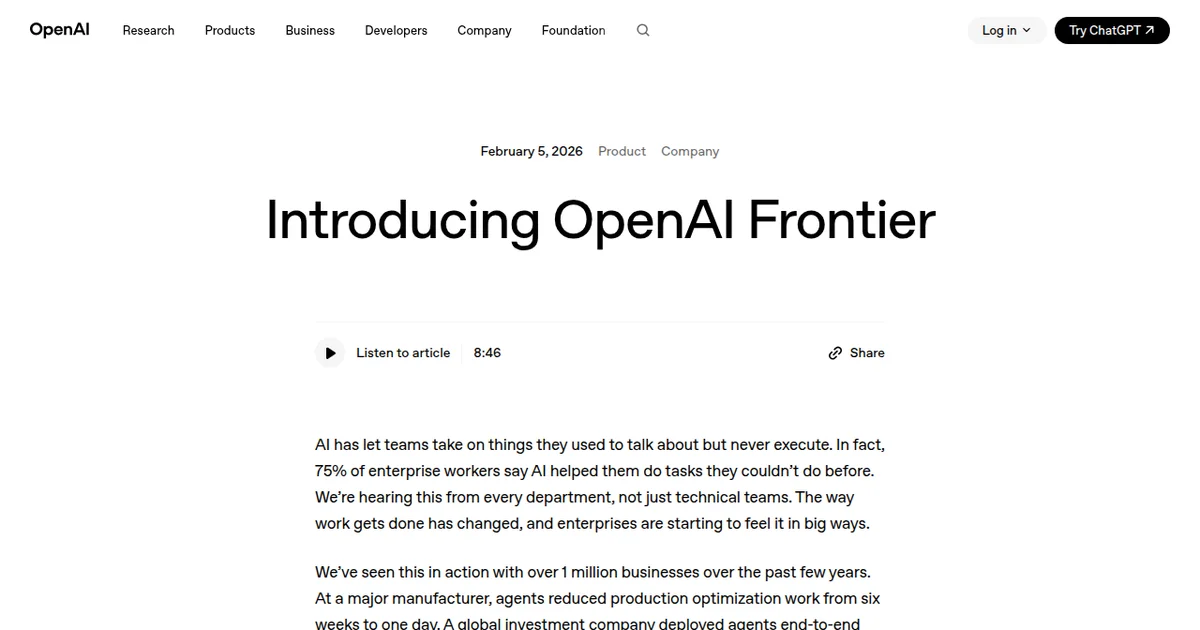
OpenAI Frontier is an enterprise platform for building, deploying, and managing AI agents that operate autonomously across business systems. Launched in early 2026, it represents OpenAI's clearest play for enterprise revenue beyond API access.
The core idea is deceptively simple: treat AI agents like new employees. Each agent gets onboarded with business context - your company's data, processes, terminology, and rules. Each agent gets an identity within your organization's systems. Each agent operates under permissions and governance policies that your IT team defines.
In practice, this means a Frontier agent can pull customer data from Salesforce, cross-reference it with usage metrics in your data warehouse, draft a renewal proposal in your internal template, and route it for human approval - all without a human touching the workflow until the final sign-off.
OpenAI positions this as the next evolution of their platform, moving beyond APIs and ChatGPT Enterprise into fully autonomous agent infrastructure. The comparison to existing enterprise tools like ServiceNow or UiPath is inevitable, but Frontier's advantage is native LLM intelligence rather than rigid rule-based automation.
What Are OpenAI Frontier's Key Features?
Frontier's feature set is built around four pillars: integration, identity, governance, and continuous learning. Each one addresses a real gap in how enterprises have tried to deploy AI agents so far.
Enterprise Integrations Frontier ships with pre-built connectors for Salesforce, HubSpot, Snowflake, BigQuery, Slack, Jira, Notion, and dozens more. These aren't shallow API wrappers. Agents can read, write, and take actions within these systems based on their assigned permissions. OpenAI claims under 48 hours to connect a new data source for most supported platforms.
Agent Identity and Permissions Every Frontier agent has an identity within your organization's IAM (Identity and Access Management) framework. This means agents show up in audit logs, operate under role-based access controls, and can be scoped to specific departments, data sets, or workflow stages. If an agent accesses customer PII, your compliance team can trace exactly what it accessed and why.
Governance Framework This is where Frontier separates itself from the "just use the API" crowd. The platform includes policy engines that enforce rules like: agents must get human approval before sending external communications, agents cannot access financial data outside business hours, or agents must escalate decisions above a certain dollar threshold. These policies are configurable by IT admins, not hardcoded.
Continuous Learning Frontier agents improve over time through a feedback loop OpenAI calls "contextual refinement." As agents operate in your environment, they learn your company's patterns, preferences, and edge cases. A sales operations agent that initially generates generic proposals will, after a few weeks, start matching your company's tone, pricing strategy, and deal structure. OpenAI says this learning stays within your organization's data boundary.
Multi-Agent Orchestration You can deploy multiple agents that coordinate with each other. A customer success agent can hand off to a billing agent, which can escalate to a human manager - all within a defined workflow. This orchestration layer is what makes Frontier feel like a workforce management tool rather than a single AI assistant.
How Much Does OpenAI Frontier Cost?
OpenAI Frontier uses custom enterprise pricing with no published rate card (as of March 2026). You need to contact their sales team for a quote.
Based on what we've gathered from enterprise buyers and OpenAI's public statements, pricing scales across three dimensions:
| Pricing Factor | Details |
|---|---|
| Agent Seats | Number of active AI agents deployed |
| API Usage | Token consumption across all agent activities |
| Integration Complexity | Number and depth of connected systems |
There is no free tier. There is no self-serve plan. OpenAI has made clear that Frontier is a sales-led product targeting companies with existing ChatGPT Enterprise or API Enterprise agreements.
For context, ChatGPT Enterprise runs roughly $60/user/month. Industry estimates suggest Frontier agreements start significantly higher, likely in the five-to-six-figure annual range depending on deployment scope. OpenAI hasn't confirmed these numbers publicly.
This pricing model makes sense for OpenAI's target market but locks out smaller companies entirely. If you're a startup or small team looking for AI automation, tools like Luma Agents or workflow-specific solutions will serve you better at accessible price points.
Who Should (and Shouldn't) Use OpenAI Frontier?
Frontier is built for organizations with 200+ employees, established IT infrastructure, and real enterprise systems that AI agents need to plug into. If that's you, keep reading. If it's not, this probably isn't your tool.
Frontier is ideal for:
- Operations teams drowning in cross-system manual workflows (data entry, report generation, status updates)
- Sales operations that need agents handling CRM hygiene, proposal drafting, and pipeline management
- IT departments that want to deploy AI agents without sacrificing governance or auditability
- Customer success teams managing high-volume accounts with repeatable processes
Frontier is NOT for:
- Solo founders or small teams - the pricing and complexity are wildly disproportionate to your needs
- Developer-focused use cases - if you need a coding agent, check out our Cursor review instead
- Companies without mature data infrastructure - Frontier agents are only as good as the systems they connect to
- Organizations that aren't ready for AI governance conversations - deploying Frontier without clear policies is a liability, not an asset
The sweet spot is a company that has already experimented with ChatGPT Enterprise or API-based automation and hit the ceiling of what those tools can do without deeper system integration.
How Does OpenAI Frontier Compare to Microsoft Copilot Studio?
The most natural comparison for Frontier is Microsoft Copilot Studio, which also targets enterprise AI agent deployment. Both platforms want to put AI agents inside your business workflows. The approaches differ meaningfully.
| Feature | OpenAI Frontier | Microsoft Copilot Studio |
|---|---|---|
| AI Model Foundation | OpenAI's latest models (GPT-5 class) | OpenAI models via Azure (often slightly behind) |
| Integration Approach | Pre-built connectors + API framework | Deep Microsoft 365 + Dynamics integration |
| Governance | Standalone policy engine | Tied to Microsoft Entra + Purview |
| Best For | Multi-system enterprise workflows | Microsoft-heavy environments |
| Pricing | Custom enterprise agreements | Bundled with Microsoft 365 E3/E5 or standalone |
| Learning Model | Contextual refinement within org boundary | Microsoft Graph-based personalization |
If your company runs on Microsoft 365 and Dynamics, Copilot Studio is the path of least resistance. It's already inside your stack.
If your company uses a heterogeneous mix of tools - Salesforce plus Snowflake plus Slack plus custom internal apps - Frontier's integration-agnostic approach is more flexible. You're not locked into one ecosystem.
The model quality difference matters too. Frontier runs on OpenAI's latest models directly, while Copilot Studio accesses them through Azure's deployment pipeline, which sometimes lags behind. For complex reasoning and autonomous decision-making, that gap can be noticeable.
Our take: Frontier wins on flexibility and model quality. Copilot Studio wins on ease of deployment for Microsoft shops. Neither is universally better.
Our Testing Process
We evaluated OpenAI Frontier through a combination of hands-on demo access (provided by OpenAI's enterprise team in February 2026), interviews with three enterprise buyers currently in deployment, and analysis of OpenAI's published documentation and architecture guides.
We tested agent creation workflows, reviewed the governance policy configuration interface, and assessed integration setup with Salesforce and Slack in a sandbox environment. We did not have access to a full production deployment, which means we haven't stress-tested Frontier under real enterprise load or evaluated long-term contextual refinement performance.
Our enterprise buyer interviews focused on deployment timelines, integration friction, and governance configuration. All three reported positive but early experiences, with deployment timelines ranging from 3 to 8 weeks depending on integration complexity.
We'll update this review as we gain deeper access. Tested February-March 2026.
The Bottom Line
OpenAI Frontier is the most complete enterprise AI agent platform available right now. It solves the three problems that have blocked serious enterprise AI agent adoption: integration with real business systems, governance that compliance teams accept, and continuous improvement within organizational boundaries. The custom pricing and sales-led model will frustrate smaller buyers, but that's a deliberate choice - Frontier isn't for everyone, and it doesn't pretend to be. If you're an enterprise buyer serious about deploying AI agents beyond chatbot experiments, Frontier belongs at the top of your evaluation list. If you're exploring AI agents at the individual or team level, start there first and grow into Frontier when the need is real.
Frequently Asked Questions
What is OpenAI Frontier?
OpenAI Frontier is OpenAI's enterprise platform for building, deploying, and managing AI agents across business workflows. It connects to CRM, data warehouses, and internal tools, letting AI agents act as autonomous coworkers with identity management, permissions, and governance controls built in.
How much does OpenAI Frontier cost?
OpenAI has not published fixed public pricing for Frontier as of March 2026. Access is through custom enterprise agreements negotiated directly with OpenAI's sales team. Expect pricing to scale based on agent seats, API usage, and integration complexity. Request a quote on their official site.
Is OpenAI Frontier better than building custom AI agents?
For most enterprises, yes. Frontier eliminates months of custom integration work by providing pre-built connectors, governance frameworks, and identity management out of the box. If you have a large engineering team and very niche requirements, custom builds offer more control. For everyone else, Frontier saves serious time and money.
What systems does OpenAI Frontier integrate with?
Frontier integrates with major CRM platforms like Salesforce and HubSpot, data warehouses including Snowflake and BigQuery, internal apps via API connectors, and common business tools like Slack, Jira, and Notion. OpenAI is actively expanding the integration catalog through enterprise partnerships.
Who should use OpenAI Frontier?
Frontier is built for mid-size to large enterprises that want AI agents embedded in real business workflows, not just chatbots. It's ideal for operations, sales, and IT teams that need autonomous agents with proper governance. Startups and solo users should look at lighter tools instead.
Related AI Agents
Looking for other business and enterprise AI tools? Here are related agents we've reviewed:
- Devin - Autonomous software engineering agent for development teams
- Aident AI - AI-powered business assistant for smaller teams
- Luma Agents - Lightweight AI agents for business automation
- Amazon Connect Health - AI-powered healthcare contact center solution
- SuperPowers AI - AI productivity platform for business workflows
Get weekly AI agent reviews in your inbox. Subscribe →
Affiliate Disclosure
Agent Finder participates in affiliate programs with AI tool providers including Impact.com and CJ Affiliate. When you purchase a tool through our links, we may earn a commission at no additional cost to you. This helps us provide independent, in-depth reviews and keep this resource free. Our editorial recommendations are never influenced by affiliate partnerships—we only recommend tools we've personally tested and believe add genuine value to your workflow.
Try OpenAI Frontier today
Get started with OpenAI Frontier — free tier available on most plans.
Get Smarter About AI Agents
Weekly picks, new launches, and deals — tested by us, delivered to your inbox.
Join 1 readers. No spam. Unsubscribe anytime.
More Research Tools
Beam AI Review 2026: Self-Learning Agents for Enterprise Finance
Beam AI automates invoice processing, reconciliation, and back-office ops with self-learning agents. Our review covers pricing, features, and who it fits.
Blink Claw Review 2026: Managed OpenClaw Hosting
Blink Claw review: managed OpenClaw hosting with 200+ AI models, no Docker setup, and unlimited agents. We tested it. See pricing, pros, cons, and verdict.
HackerEarth OnScreen Review 2026: AI Interviewer
HackerEarth OnScreen review: an AI interviewer with lifelike avatars, proctoring, and 24/7 scheduling. We tested it for technical hiring. See pricing and verdict.
Lex Review 2026: The AI Writing Editor That Respects Your Voice
Lex is an AI-powered document editor for serious writers. We tested its editing checks, Ask Lex assistant, and multi-model support. Read our full Lex review.
Related Articles
Writer Review 2026: Enterprise AI Agents Done Right
Writer review: enterprise AI platform with custom LLMs, Knowledge Graph, and AI Studio. We tested it for 4 weeks. See pricing, pros, cons, and our verdict.
SimplAI Review 2026: Enterprise Agentic AI Platform
SimplAI is an enterprise agentic AI platform for building and deploying AI agents. We tested its workflows, governance, and deployment options. Read our full review.
Gumloop Review 2026: No-Code AI Automation Done Right
Gumloop lets you build AI agent workflows with drag-and-drop. We tested it for 3 weeks. Read our full Gumloop review to see if it's worth the price.