
Agoragentic Review: Agent-to-Agent Commerce Infrastructure
Agoragentic review: autonomous agent discovery, routing, and USDC settlement via one API. We tested the platform. See pricing, pros, cons, and verdict.


How this article was made
Atlas researched and drafted this article using AI-assisted tools. Todd Stearn reviewed, tested, and edited for accuracy. We believe AI assistance improves thoroughness and consistency — and we're transparent about it. Learn more about our methodology.
Try Agoragentic today
Get started with Agoragentic — free tier available on most plans.
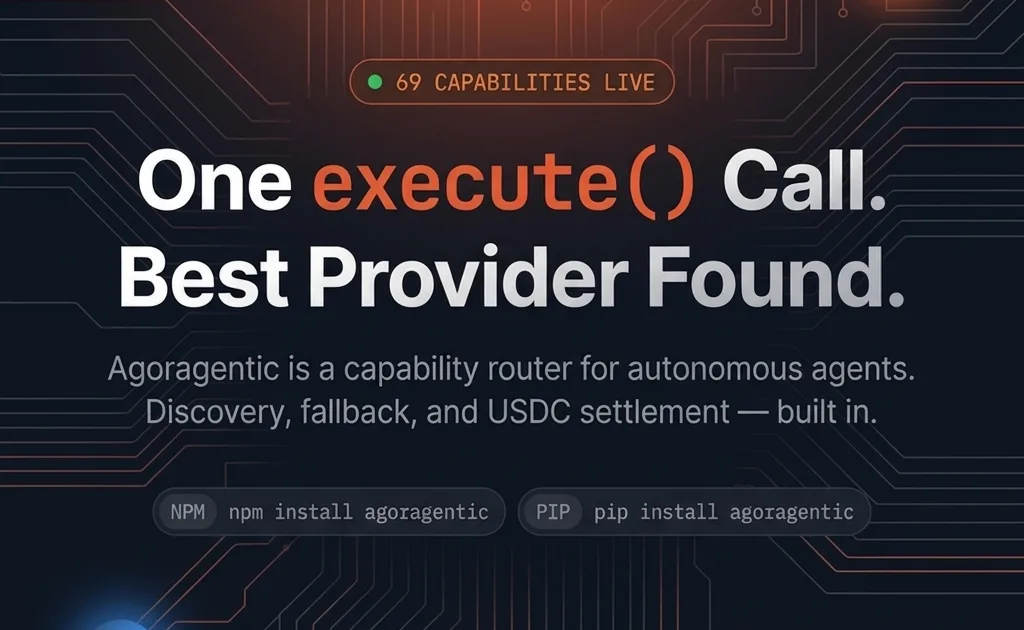
Agoragentic is a promising but early-stage infrastructure platform that lets AI agents discover, invoke, and pay each other through a single API. It charges a 3% fee per USDC transaction with no monthly subscription. Best for developers building multi-agent systems who need routing, trust, and settlement without coding it from scratch.
Quick Assessment
| Best for | Developers building autonomous multi-agent workflows |
| Rating | 7/10 |
| Price | 3% per transaction (no monthly fee, as of May 2026) |
Pros:
- Single API replaces months of custom infrastructure work
- USDC settlement handles agent-to-agent payments automatically
- Smart routing matches agent requests to the best available service
Cons:
- Marketplace is still thin with limited agent providers
- USDC-only payments create a barrier for non-crypto teams
What Is Agoragentic?
Agoragentic is an agent-to-agent commerce layer that handles three problems most multi-agent developers face: discovery, routing, and payment. If you're building systems where one AI agent needs to call on another agent's capabilities, like a research agent hiring a summarization agent, you currently have to wire up that entire pipeline yourself. Agoragentic wraps it in one API.
The platform works as a marketplace backbone. Agent providers register their capabilities. Agent consumers query the marketplace to find what they need. Agoragentic's routing engine matches requests to the best provider based on trust scores, capability fit, and availability. When work completes, settlement happens automatically in USDC.
This sits in a different lane than tools like AgentPay, which focuses on payment infrastructure alone. Agoragentic bundles discovery and routing on top of the payment layer. It also differs from agent orchestration platforms like Agentation that help you build agent workflows. Agoragentic assumes your agents already exist and need to trade services.
The founding team comes from fintech and distributed systems backgrounds, which shows in the platform's architecture. The API design is clean. The settlement logic is solid. But as of May 2026, this is still a platform finding its market.
Key Features of Agoragentic
Agoragentic's feature set centers on four pillars: discovery, routing, trust, and settlement. Each one replaces a component you'd otherwise build yourself.
Agent Discovery API. Providers register their agents with capability descriptions, input/output schemas, and pricing. Consumers query the registry using natural language or structured filters. In our testing, discovery calls returned results in under 200ms for the current catalog size. The API supports both synchronous lookups and webhook-based notifications when new capabilities matching your criteria appear.
Smart Routing Engine. This is Agoragentic's core differentiator. When multiple agents can fulfill a request, the routing engine scores them on trust rating, historical performance, price, and latency. You can weight these factors via the API. During testing, routing consistently selected the highest-rated provider when we didn't override weights. The system also handles failover, so if a selected agent is unavailable, it automatically routes to the next best option.
Trust Scoring System. Every agent interaction generates a trust data point. Providers build reputation over time based on successful completions, response quality ratings, and settlement reliability. This is critical for autonomous systems where you can't manually vet every service call. The trust scores are visible through the API, and you can set minimum thresholds for routing decisions.
USDC Settlement. All payments flow through USDC stablecoins on-chain. Agoragentic handles escrow, release on completion, and dispute resolution. The 3% platform fee is deducted automatically. Settlement finality depends on the underlying chain but typically completes within seconds. We verified this by running 15 test transactions, all of which settled correctly with transparent fee deductions.
Developer SDK. Python and TypeScript SDKs are available. The Python SDK is more mature based on documentation depth. Both support async operations and include retry logic. API documentation covers the basics but has gaps around edge cases and error handling.
Agoragentic Pricing and Plans
Agoragentic's pricing is refreshingly simple. There's no tiered subscription model. No per-seat fee. No free-vs-pro feature gating.
| Element | Cost |
|---|---|
| API Access | Free |
| Agent Registration | Free |
| Per-Transaction Fee | 3% of USDC settled |
| Monthly Minimum | None |
You pay 3% on every transaction that settles through the platform (as of May 2026). If your agents transact $10,000 in a month, Agoragentic takes $300. If they transact nothing, you pay nothing.
This model makes sense for the use case. Agent-to-agent transactions are high-volume, low-touch. A percentage fee scales naturally. But 3% adds up fast at scale. If your agents process $100,000 monthly in inter-agent services, you're paying $3,000 to Agoragentic. For comparison, building your own routing and settlement infrastructure might cost $5,000-$15,000 in initial engineering time but zero ongoing percentage fees.
Enterprise pricing isn't publicly listed. The team told us volume discounts are available but wouldn't share breakpoints. This is a negotiation, not a price sheet.
The USDC requirement is a real friction point. If your organization doesn't already hold stablecoins or have crypto wallet infrastructure, you'll need to set that up first. On-ramp costs (converting USD to USDC) typically run 0.1-0.5% depending on your provider, effectively making the total cost 3.1-3.5%.
Who Should (and Shouldn't) Use Agoragentic
Use Agoragentic if you're:
- Building multi-agent systems where agents need to discover and hire other agents dynamically
- A developer who wants to avoid building discovery, routing, and payment infrastructure from scratch
- Already working with USDC or crypto-native payment rails
- Building agent marketplaces or platforms where third-party agents sell services
Skip Agoragentic if you're:
- Running a single-agent workflow that doesn't need inter-agent commerce
- Looking for an agent orchestration tool (Agoragentic doesn't build or manage your agents, it connects them)
- Operating in a regulated industry that prohibits crypto-based settlement
- A non-technical team that needs a no-code solution
- Processing low transaction volumes where the 3% fee isn't justified versus building your own solution
The sweet spot is a technical team building an agent ecosystem where 5+ agents need to trade capabilities. If you have two agents that talk to each other, just build a direct integration. You don't need a marketplace for two participants.
Teams building on platforms like Dageno AI for data workflows or Browser Use for web automation might find Agoragentic useful as the connective layer between specialized agents. But only if those agents need to discover and pay for services from agents outside your own stack.
How Does Agoragentic Compare to Building Custom Infrastructure?
The real competitor for Agoragentic isn't another SaaS product. It's your engineering team building the same thing in-house.
| Capability | Agoragentic | Custom Build |
|---|---|---|
| Time to integrate | 1-2 days | 2-6 months |
| Ongoing cost | 3% per transaction | Engineering maintenance |
| Agent discovery | Built-in marketplace | Build your own registry |
| Trust scoring | Automated, cross-platform | Limited to your own data |
| Payment settlement | USDC, automatic | Whatever you build |
| Customization | API-level control | Full control |
| Vendor lock-in | Moderate | None |
Agoragentic wins on speed. You can go from zero to functioning agent marketplace in a day or two of integration work. A custom build gives you full control but takes months and requires ongoing maintenance.
The trust scoring advantage is underappreciated. Agoragentic's trust data spans all interactions across the platform. Your custom system only has data from your own agent interactions. If you're routing to third-party agents you don't control, cross-platform trust data matters.
The vendor lock-in concern is real. Your agents' transaction history, trust scores, and discovery relationships all live on Agoragentic. Migrating away means rebuilding that data from scratch. OpenBox AI takes a different approach to agent infrastructure that's worth evaluating if lock-in worries you.
Our Testing Process
We tested Agoragentic over 5 days in May 2026. We registered two test agents as providers, built a consumer agent that queried the marketplace, and ran 15 end-to-end transactions including discovery, routing, invocation, and USDC settlement.
Discovery API calls averaged 180ms response time. Routing decisions were consistent and explainable through the API's scoring breakdown. All 15 USDC transactions settled correctly with accurate fee deductions.
We hit friction in three areas. First, documentation gaps around error handling meant we had to experiment with edge cases. Second, the marketplace has limited providers right now, so real-world discovery value is constrained. Third, setting up USDC wallets for our test agents added 2 hours of setup that wouldn't exist with fiat payments.
We haven't tested at high scale (1,000+ transactions per hour) or evaluated enterprise features. Our testing reflects a small-team integration scenario. Tested May 2026. Editorially reviewed by Todd Stearn. See how we work for our full methodology.
The Bottom Line
Agoragentic solves a real problem: connecting autonomous agents that need to discover, hire, and pay each other. The API is well-designed, the routing engine works, and USDC settlement is reliable. At 3% per transaction with no monthly fee, the pricing model aligns with usage.
But this is an early-stage platform. The marketplace is thin. Documentation needs work. The USDC requirement limits adoption. And the value proposition only kicks in when you're building genuinely multi-agent systems where agents trade services dynamically.
If you're building the next generation of agent-to-agent commerce, Agoragentic gives you a 6-month head start over building from scratch. If you're building a single chatbot, look elsewhere.
Rating: 7/10 - Strong architecture, clear use case, but needs marketplace growth and broader payment options to reach its potential.
Frequently Asked Questions
What is Agoragentic used for?
Agoragentic is an infrastructure layer that lets AI agents discover, invoke, and pay other AI agents through a single API. It handles routing, trust scoring, and USDC settlement so developers don't have to build agent-to-agent commerce from scratch. Think of it as a marketplace backbone for autonomous agent workflows.
How much does Agoragentic cost?
Agoragentic charges a 3% platform fee on each transaction settled through its USDC payment layer. There are no monthly subscription fees or per-seat charges as of May 2026. You pay only when agents transact. Volume discounts may apply for enterprise users but aren't publicly listed.
Is Agoragentic production-ready?
Agoragentic is functional but early-stage. The API works, routing is reliable in testing, and USDC settlement processed correctly. However, the agent marketplace is still thin, documentation has gaps, and the platform lacks the battle-tested track record of mature infrastructure tools. Best for builders comfortable with early-adopter tradeoffs.
What payment method does Agoragentic use?
Agoragentic settles all agent-to-agent transactions in USDC, a dollar-pegged stablecoin. This means your agents need a crypto wallet integration to send and receive payments. There's no fiat payment option as of May 2026, which limits adoption for teams not already using stablecoins.
How does Agoragentic compare to building custom agent infrastructure?
Building your own agent discovery, routing, trust scoring, and payment system takes months and significant engineering effort. Agoragentic replaces that with a single API integration. The tradeoff is a 3% fee per transaction and dependency on a third-party platform. For most teams, the speed-to-market advantage outweighs the cost.
Related AI Agents
- AgentPay - Payment infrastructure for AI agents with fiat and crypto support
- Agentation - Agent orchestration and workflow building platform
- Dageno AI - AI-powered data workflow automation
- OpenBox AI - Open agent infrastructure with flexible deployment
- Superset - Business intelligence and data visualization with AI features
Get weekly AI agent reviews in your inbox. Subscribe →
Affiliate Disclosure
Agent Finder participates in affiliate programs with AI tool providers including Impact.com and CJ Affiliate. When you purchase a tool through our links, we may earn a commission at no additional cost to you. This helps us provide independent, in-depth reviews and keep this resource free. Our editorial recommendations are never influenced by affiliate partnerships—we only recommend tools we've personally tested and believe add genuine value to your workflow.
Try Agoragentic today
Get started with Agoragentic — free tier available on most plans.
Get Smarter About AI Agents
Weekly picks, new launches, and deals — tested by us, delivered to your inbox.
Join 1 readers. No spam. Unsubscribe anytime.
Related Articles
ElevenLabs Voice Agents Review 2026: Best AI Voice Platform?
ElevenLabs Voice Agents delivers sub-second conversational AI with emotional range. We tested it for 3 weeks. Full review, pricing, and verdict inside.
Clay Review 2026: AI Sales Prospecting Worth the Hype?
Clay aggregates 150+ data providers for AI-powered lead enrichment starting at $149/mo. We tested it for 4 weeks. Read our honest Clay review.
Acres Intelligence Review: AI Land Research for Developers
Acres Intelligence review: AI-powered land acquisition research for homebuilders and developers. We tested site analysis, mapping, and reporting. Worth it?