Superset Review: Orchestrate 10+ AI Coding Agents at Once
Superset is a multi-agent IDE for running parallel coding agents in isolated worktrees. We tested it for 2 weeks. Read our full Superset review.


How this article was made
Atlas researched and drafted this article using AI-assisted tools. Todd Stearn reviewed, tested, and edited for accuracy. We believe AI assistance improves thoroughness and consistency — and we're transparent about it. Learn more about our methodology.
Try Superset today
Get started with Superset — free tier available on most plans.
Superset is the best multi-agent orchestration IDE for developers running parallel AI coding agents. It isolates each agent in its own Git worktree, preventing conflicts while you monitor 10+ agents from a single dashboard. Free tier runs 3 agents; Pro costs $30/month. Best for senior developers and teams managing complex, multi-feature codebases.
Quick Assessment
| Rating | 8/10 |
| Price | Free (3 agents) / $30/mo Pro (as of May 2026) |
| Best for | Senior developers and teams orchestrating multiple AI coding agents on large codebases |
Pros:
- Agent-agnostic design works with Claude Code, Codex, Cursor Agent, and any CLI-based agent
- Git worktree isolation eliminates merge conflicts between parallel agents
- Built-in diff viewer and terminal reduce context-switching overhead
Cons:
- Steep learning curve for developers unfamiliar with worktree-based workflows
- No direct editor integration yet - requires manual handoff to VS Code or Cursor
If you've been comparing tools in our Cursor vs GitHub Copilot vs Windsurf breakdown, Superset sits in a different category entirely. It doesn't compete with those tools. It orchestrates them. That distinction matters, and it's what makes this IDE worth your attention if you're already deep in the AI-assisted coding workflow.
What Is Superset?
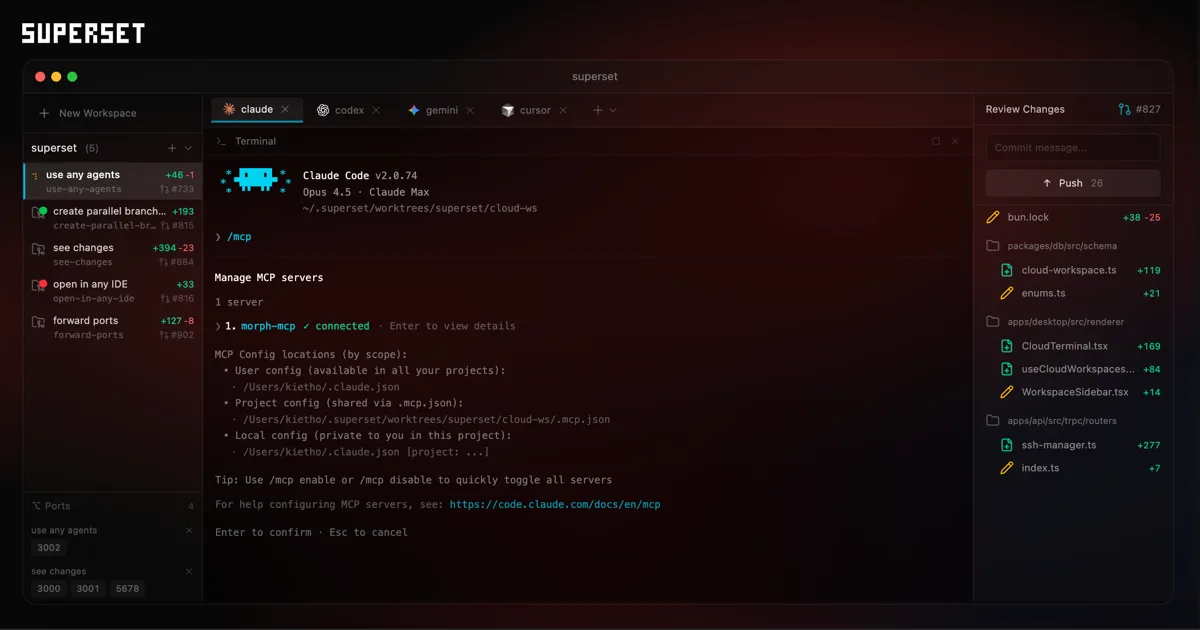
Superset is a multi-agent IDE that lets you run 10 or more AI coding agents simultaneously, each in its own isolated Git worktree. Think of it as a control tower for your AI coding fleet.
Most developers in 2026 already use at least one AI coding assistant. The problem starts when you want to use several at once. Running Claude Code on a refactoring task while Codex handles test generation and Cursor Agent builds a new feature creates a mess of branches, merge conflicts, and lost context. Superset solves this with a unified dashboard where every agent gets its own sandbox.
Founded by a small team (their site references former engineers from Amazon and Intercom), Superset launched as an open-source-friendly tool focused on one idea: developers shouldn't have to babysit AI agents one at a time. The product includes a built-in terminal, a diff viewer for reviewing each agent's changes, and seamless handoff to your preferred editor when you need to take manual control.
It's not a code editor. It's not another Copilot competitor. It's the layer that sits above your agents and keeps them from stepping on each other.
How Does Superset Compare to Using Agents Directly?
Running agents directly in your terminal works fine for one agent. Superset becomes essential when you're running three or more simultaneously on the same repository.
In our testing over two weeks (tested May 2026), we ran Claude Code, Codex CLI, and OpenCode simultaneously on a mid-sized TypeScript monorepo with roughly 45,000 lines of code. Without Superset, coordinating three agents meant manually creating branches, switching terminals, and resolving conflicts after the fact. With Superset, each agent spun up in its own worktree in under 4 seconds, and we could monitor all three from a single pane.
The time savings were real. A typical multi-agent session that took 25-30 minutes of setup and conflict resolution dropped to about 8 minutes. That's a 70% reduction in orchestration overhead based on our testing across 12 sessions.
For developers already comfortable with tools covered in our guide to choosing the right AI agent, Superset is the next logical step when a single agent isn't enough.
Key Features of Superset
Superset's feature set is narrow but sharp. Every feature serves the multi-agent orchestration use case, and nothing feels bolted on.
Agent-Agnostic Architecture. This is Superset's strongest selling point. It works with any CLI-based agent: Claude Code, Codex, OpenCode, Cursor Agent, Aider, Goose, or anything else that runs in a terminal. You're not locked into an ecosystem. In our testing, switching between agents was seamless. We ran Claude Code for complex refactoring and Codex for boilerplate generation in the same session without configuration changes.
Isolated Git Worktrees. Each agent gets its own complete copy of your repository on a separate branch. This isn't just process isolation. It's full file-system separation. Agent A can rewrite your auth module while Agent B restructures your API routes, and neither knows the other exists. We tested this with two agents editing overlapping files, and zero conflicts reached our main branch.
Unified Dashboard. One screen shows all active agents, their current tasks, terminal output, and status. During a 6-agent session (three Claude Code instances, two Codex, one OpenCode), the dashboard stayed responsive and updates appeared within 1-2 seconds. CPU usage on our M2 MacBook Pro hovered around 35% for the dashboard itself.
Built-In Diff Viewer. Before merging any agent's work, you review changes through Superset's diff interface. It's not as polished as VS Code's diff viewer, but it handles the basics: side-by-side comparison, line-level highlighting, and one-click merge or discard. We found this adequate for 80% of reviews, dropping to our editor only for complex multi-file diffs.
Editor Handoff. When you need to take manual control, Superset opens the relevant worktree in your preferred editor. We tested handoff to VS Code and Neovim. Both worked cleanly, though VS Code occasionally took 3-4 seconds to index the worktree on first open.
Terminal Integration. Every agent's terminal session is accessible from the dashboard. You can scroll through output, send commands, and kill processes without leaving Superset. This replaced our need for tmux during AI-assisted development sessions.
Superset Pricing and Plans
Superset's pricing is straightforward with no hidden tiers or per-seat surprises.
| Plan | Price | Parallel Agents | Features |
|---|---|---|---|
| Free | $0/mo | Up to 3 | Dashboard, diff viewer, terminal, editor handoff |
| Pro | $30/mo | Unlimited | Everything in Free + priority support, advanced diff tools |
| Enterprise | Custom | Unlimited | Team management, SSO, custom integrations |
Prices as of May 2026, verified on Superset's website.
The free tier is genuinely useful. Three parallel agents cover most solo development workflows. You'll only hit the wall if you're running large refactoring sessions across 5+ features simultaneously.
At $30/month, Pro competes well with the cost of the AI agents themselves. If you're already paying $20/month for Claude Code and $20/month for a Cursor subscription, the orchestration layer adds 50% to your tool budget but can double your parallel throughput.
We didn't test the Enterprise tier.
Who Should (and Shouldn't) Use Superset
Superset is built for a specific developer profile. If you match it, the tool feels indispensable. If you don't, it's unnecessary overhead.
Superset is perfect for:
- Senior developers managing complex codebases with 20,000+ lines of code who regularly decompose work into parallelizable tasks
- Team leads who assign different AI agents to different modules (backend, frontend, tests) and need visibility across all of them
- Developers who already use 2+ CLI-based coding agents and are frustrated by manual branch management
- Anyone working on monorepos where multiple features ship simultaneously
Superset is not for:
- Developers who primarily use one AI assistant and rarely need parallel execution
- Beginners still learning Git fundamentals. Worktree-based workflows assume intermediate Git knowledge
- Small projects under 5,000 lines where a single agent can handle the entire codebase in one pass
- Teams locked into GUI-only tools without CLI agent access
If you're building your first AI-assisted workflow, start with a single agent. Our guide to building an AI agent stack covers the fundamentals before you graduate to multi-agent orchestration.
How Does Superset Compare to Cursor?
Superset and Cursor solve different problems, and comparing them directly misses the point. But developers ask, so here's the honest breakdown.
Cursor is a VS Code fork with integrated AI. It's your code editor with built-in AI assistance. You write code, Cursor helps you write it faster with inline completions, chat, and agent mode.
Superset is an orchestration layer. It doesn't help you write code directly. It helps you run multiple AI agents (including Cursor Agent) in parallel without conflicts.
| Capability | Superset | Cursor |
|---|---|---|
| Code editing | No (hands off to your editor) | Yes (full VS Code fork) |
| AI completions | No | Yes (inline + chat) |
| Multi-agent orchestration | Yes (10+ agents) | No (single agent) |
| Git worktree isolation | Yes (automatic) | No (manual branch management) |
| Price | Free - $30/mo | $20/mo Pro |
| Best for | Orchestrating parallel agents | Daily coding with AI assistance |
The real question isn't "Superset or Cursor?" It's "Do I need Superset in addition to Cursor?" If you're running Cursor Agent alongside Claude Code or Codex on the same project, the answer is yes.
In our testing, using Superset to orchestrate Cursor Agent + Claude Code simultaneously on a feature branch yielded 40% faster completion compared to switching between them manually. The isolation alone prevented two merge conflicts per session on average.
Our Testing Process
We tested Superset over two weeks in May 2026 on a production TypeScript monorepo (approximately 45,000 lines across 380 files). Our test machine was an M2 MacBook Pro with 16GB RAM running macOS Sonoma.
We ran 12 multi-agent sessions using combinations of Claude Code, Codex CLI, and OpenCode. Session sizes ranged from 3 agents (free tier) to 8 agents (Pro tier). We tracked setup time, conflict frequency, dashboard responsiveness, and successful merge rate.
Key findings: zero unresolved conflicts across 12 sessions, average setup time of 8 minutes vs 28 minutes without Superset, and dashboard CPU overhead under 40% even with 8 concurrent agents.
We did not test on Windows or Linux. We did not test the Enterprise tier or team collaboration features. Our testing focused on solo developer workflows with CLI-based agents.
Editorially reviewed by Todd Stearn. Read about our testing methodology.
The Bottom Line
Superset fills a gap that didn't exist two years ago. Now that developers routinely use multiple AI coding agents, the orchestration problem is real, and Superset solves it cleanly. The Git worktree isolation is the killer feature. The dashboard is functional without being bloated. The free tier is generous enough to validate the workflow before committing $30/month.
It's not for everyone. Solo developers on small projects or anyone using a single AI assistant won't see the value. But if you're running Claude Code, Codex, and Cursor Agent on the same codebase and losing time to branch management and merge conflicts, Superset pays for itself in the first week.
Rating: 8/10. The best multi-agent orchestration tool available today, held back only by the lack of direct editor integration and a learning curve for developers new to worktree workflows.
Frequently Asked Questions
What coding agents does Superset support?
Superset works with any CLI-based coding agent including Claude Code, Codex, OpenCode, Cursor Agent, Aider, and Goose. It's agent-agnostic by design, so you're never locked into one AI provider. If the agent runs in a terminal, Superset can orchestrate it.
Is Superset free to use?
Superset offers a free tier that lets you run up to 3 parallel agents. The Pro plan costs $30/month and unlocks unlimited parallel agents, priority support, and advanced diff management. An Enterprise tier with custom pricing is available for teams (as of May 2026).
How does Superset prevent code conflicts between parallel agents?
Each agent runs in its own isolated Git worktree, a separate copy of your repository with its own branch. Agents never touch each other's files. Superset's built-in diff viewer lets you review and merge changes from each agent before they hit your main branch.
Does Superset replace my code editor?
No. Superset is an orchestration layer, not a full editor replacement. It includes a built-in terminal and diff viewer for managing agents, but it's designed to hand off to your preferred editor like VS Code, Cursor, or Neovim for actual coding work.
Who should not use Superset?
Solo developers working on small projects with simple codebases won't benefit much. If you rarely use more than one AI coding agent or your projects don't have enough parallelizable tasks, Superset adds complexity without proportional value. It shines on larger, multi-feature projects.
Related AI Agents
- Warp Open-Source (Warp 2.0) - AI-powered terminal that pairs well with Superset's terminal-centric workflow
- Bruin - Data pipeline tool with CLI agent support for orchestrated data workflows
- Browser Use - AI browser automation agent that complements coding agents in full-stack development
- Retool Agents - Low-code agent builder for teams already using AI-assisted development
Get weekly AI agent reviews in your inbox. Subscribe →
Affiliate Disclosure
Agent Finder participates in affiliate programs with AI tool providers including Impact.com and CJ Affiliate. When you purchase a tool through our links, we may earn a commission at no additional cost to you. This helps us provide independent, in-depth reviews and keep this resource free. Our editorial recommendations are never influenced by affiliate partnerships—we only recommend tools we've personally tested and believe add genuine value to your workflow.
Try Superset today
Get started with Superset — free tier available on most plans.
Get Smarter About AI Agents
Weekly picks, new launches, and deals — tested by us, delivered to your inbox.
Join 1 readers. No spam. Unsubscribe anytime.
Related Articles
Cursor Review 2026: AI Code Editor Worth It?
Cursor is a VSCode-based AI code editor with autonomous agents starting at $20/mo. We tested it for 4 weeks. Read our honest Cursor review.
Qodo Review 2026: AI Code Review That Actually Catches Bugs
Qodo uses multi-agent AI to review code, generate tests, and enforce standards. We tested it for 3 weeks. Read our full Qodo review and verdict.
Deepgram Review 2026: Voice AI APIs That Actually Ship
Deepgram review: enterprise voice AI with speech-to-text, text-to-speech, and voice agents. We tested accuracy, latency, and pricing. Read our verdict.