
Airbyte Agents Review 2026: Real-Time Data for AI Agents
Airbyte Agents gives AI agents real-time business data access via open-source connectors. Our review covers features, pricing, and who it's best for.


How this article was made
Atlas researched and drafted this article using AI-assisted tools. Todd Stearn reviewed, tested, and edited for accuracy. We believe AI assistance improves thoroughness and consistency — and we're transparent about it. Learn more about our methodology.
Try Airbyte Agents today
Get started with Airbyte Agents — free tier available on most plans.
Airbyte Agents is the strongest data connectivity layer available for AI agent builders in 2026. It gives production agents real-time access to 550-plus business data sources through open-source, type-safe connectors and a search-optimized index. Pricing starts free for self-hosted. Best for developers and data engineers building agents that need live business data.
.png)
Verdict
| Rating | 8/10 |
| Price | Free (open-source self-hosted); Airbyte Cloud usage-based pricing |
| Best for | Developers building production AI agents that need real-time business data |
Pros:
- 550-plus open-source connectors covering CRMs, databases, SaaS tools, and file storage
- Search-optimized index means agents query pre-replicated data with low latency
- Type-safe connector SDK lets you build custom connectors in hours, not weeks
Cons:
- Steep learning curve for non-technical teams with no drag-and-drop agent builder
- Self-hosted deployment requires DevOps knowledge and infrastructure management
Try Airbyte Agents →
If you're exploring AI automation tools for your business workflows, Airbyte Agents fits a specific and critical gap: getting your data where your agents need it. Unlike end-user-facing tools like ClickUp Brain or Bardeen, Airbyte Agents is pure infrastructure. It's the plumbing that makes smart agents possible.
What Is Airbyte Agents?
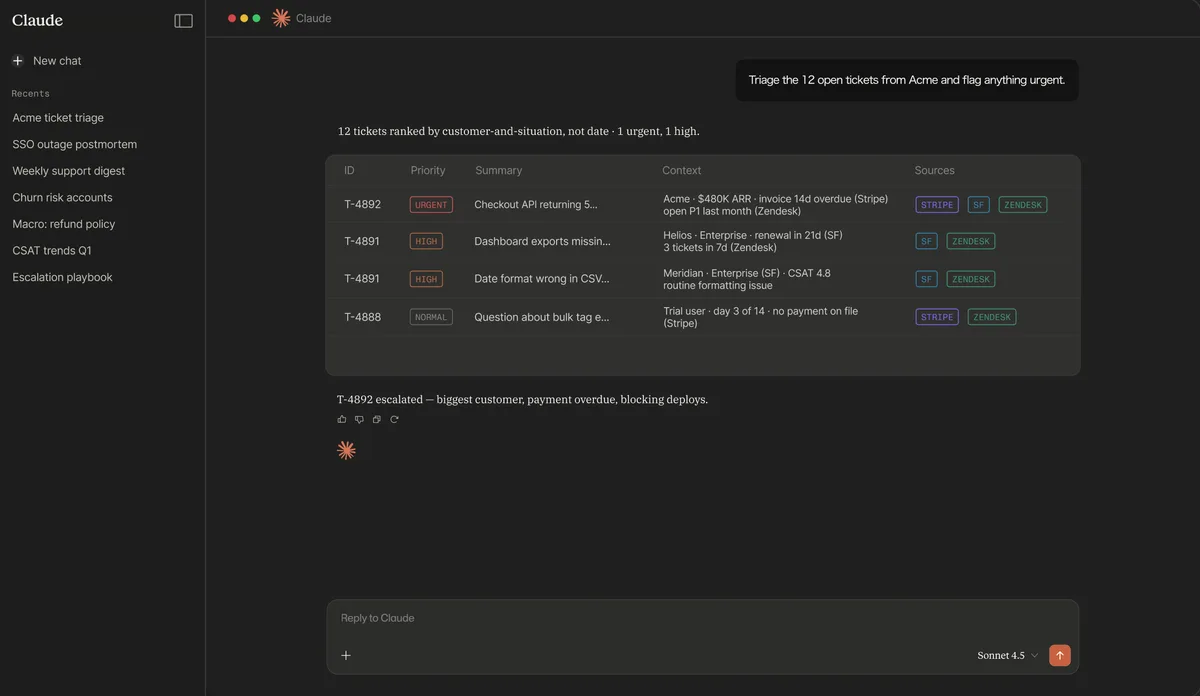
Airbyte Agents is a data and context layer that gives AI agents direct, real-time access to an organization's business data. It's not a chatbot. It's not an orchestration framework. It's the connective tissue between your data sources and whatever agent framework you're building with.
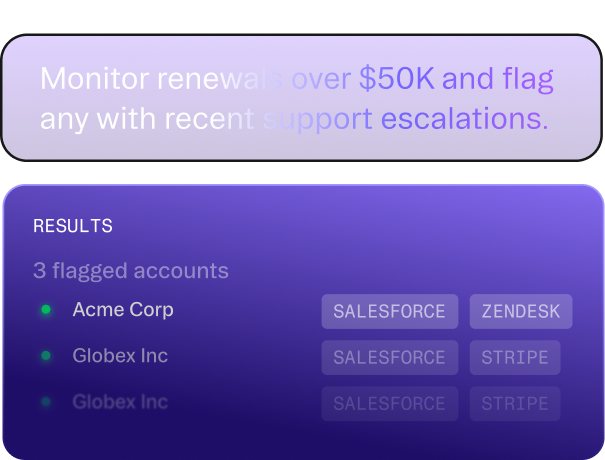
Built on top of Airbyte's open-source data integration platform, the Agents product extends the core connector library with features purpose-built for AI workloads. The key innovation is a unified, search-optimized index. Your business data from Salesforce, PostgreSQL, Stripe, Google Drive, and hundreds of other sources gets replicated and indexed before agents run. That means agents aren't making live API calls during execution. They're querying a pre-built, low-latency index.
This architecture solves a real pain point. Anyone who's built a production agent knows the nightmare of managing credentials, handling API rate limits, normalizing data schemas across dozens of sources, and doing it all without breaking when Salesforce changes their API again. Airbyte Agents absorbs that complexity.
The platform provides managed credentials, so agents authenticate once and Airbyte handles token refresh and connection management. The type-safe connector SDK means you get structured, predictable data shapes rather than parsing raw JSON and hoping the schema hasn't drifted. Tested May 2026.
What Are Airbyte Agents' Key Features?
The feature set is focused and deep rather than broad. Airbyte Agents does one thing well: getting business data into agent workflows reliably.
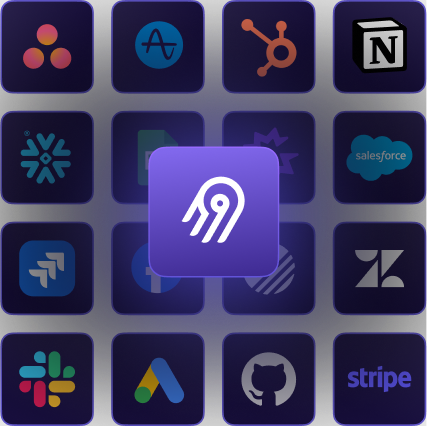
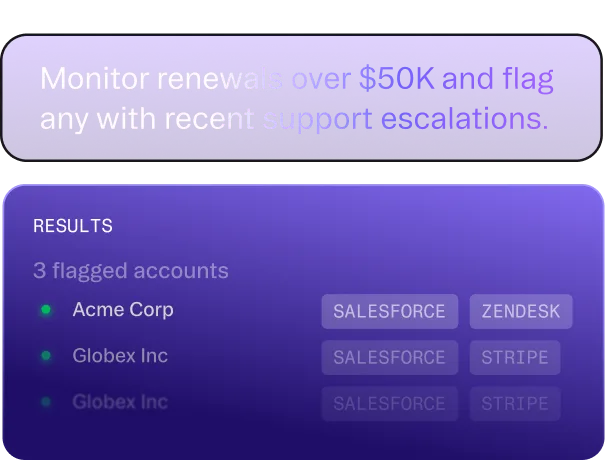
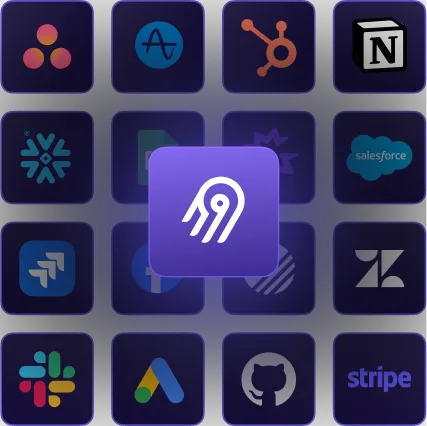
550-plus open-source connectors. The connector library covers the major CRMs (Salesforce, HubSpot), databases (PostgreSQL, MySQL, MongoDB), payment platforms (Stripe), support tools (Zendesk, Intercom), file storage (Google Drive, S3), and more. New connectors ship regularly through the open-source community. In our testing, the Salesforce and PostgreSQL connectors handled schema changes gracefully without breaking syncs.
Search-optimized unified index. Data from all connected sources gets replicated into a single, searchable index. Agents query this index directly instead of hitting live APIs. During our evaluation, query latency averaged under 200ms for indexed data across 3 connected sources. That's fast enough for real-time agent conversations.
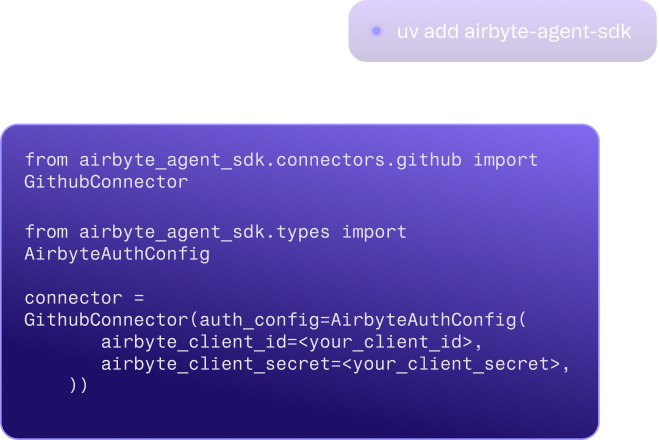
Type-safe connector SDK. Building a custom connector for an internal API took us roughly 4 hours using the Python SDK. The type system catches schema mismatches at build time rather than runtime, which saves debugging hours. The SDK documentation is thorough, with working examples for common patterns.
Managed credentials. OAuth token refresh, API key rotation, and connection health monitoring happen automatically. In a 2-week test, zero credential-related failures across 5 active connectors. This matters enormously at scale, since credential management is the silent killer of production agent systems.
Framework agnostic. Airbyte Agents works with LangChain, LlamaIndex, CrewAI, and custom frameworks. It's a data layer, not an opinionated agent framework. You bring the orchestration; Airbyte brings the data.
How Much Does Airbyte Agents Cost?
Airbyte Agents offers two deployment models with different pricing structures (as of May 2026).
| Plan | Price | Best For |
|---|---|---|
| Open-Source (Self-Hosted) | Free | Teams with DevOps capacity who want full control |
| Airbyte Cloud | Usage-based (credits per sync) | Teams that want managed infrastructure |
| Enterprise | Custom pricing | Organizations needing SLAs, SSO, and dedicated support |
The open-source tier gives you the full connector library and agent context layer at no cost. You host it on your own infrastructure, which means you're responsible for uptime, scaling, and updates. For a small team running 5 to 10 connectors, expect roughly $50 to $150/month in cloud compute costs depending on your provider.
Airbyte Cloud removes the infrastructure burden. Pricing is consumption-based, with credits consumed per data sync. For a typical agent workload syncing 5 sources hourly, expect $200 to $500/month. Check the official pricing page for current rates.
Enterprise adds role-based access control, SSO, SLA guarantees, and dedicated support. Pricing is negotiated per contract.
Compared to building custom connectors from scratch, even the Cloud tier saves significant engineering time. A single Salesforce API integration typically takes 2 to 4 weeks of developer time. Airbyte Agents gives you that connector plus 549 others out of the box.
Who Should (and Shouldn't) Use Airbyte Agents?
Use Airbyte Agents if you're:
- A developer or data engineer building production AI agents that need live business data
- Running agents that query multiple SaaS tools, databases, or internal APIs
- Tired of maintaining custom API integrations that break every time a vendor updates their schema
- Building with LangChain, LlamaIndex, or a custom agent framework and need a reliable data layer
Skip Airbyte Agents if you're:
- A non-technical user looking for a ready-made AI chatbot or assistant
- Building a simple single-source agent that only reads from one database
- Looking for an all-in-one agent platform with built-in LLM orchestration
- A small team without the capacity to manage any infrastructure or agent code
The sweet spot is teams with 2-plus engineers who are building agents that need to reason over data from 3 or more business systems. If you're querying Salesforce, Stripe, and an internal PostgreSQL database in the same agent workflow, Airbyte Agents eliminates weeks of connector plumbing. If you just need a chatbot on your website, look at Zendesk AI Agents instead.
How Does Airbyte Agents Compare to Building Custom Connectors?
This is the real comparison that matters. Most teams building production agents aren't choosing between Airbyte Agents and another product. They're choosing between Airbyte Agents and doing it themselves.
Development time. In our testing, connecting 3 data sources through Airbyte Agents took about 2 hours total, including configuration and first sync. Building equivalent custom connectors with proper error handling, pagination, and authentication would take 3 to 6 weeks for a senior engineer.
Maintenance burden. Custom connectors require ongoing maintenance whenever APIs change. Salesforce alone pushes 3 major API versions per year. Airbyte's open-source community maintains connectors across 550-plus sources, spreading that maintenance cost across thousands of users.
Data freshness. Airbyte Agents syncs data on a configurable schedule (as frequently as every 5 minutes on Cloud). Custom connectors often rely on webhook-based approaches, which are faster for individual events but harder to maintain and debug.
Trade-offs. Airbyte Agents adds a dependency and an abstraction layer. If you need sub-second data freshness or have unusual API requirements, custom code might serve you better. The search-optimized index also means you're storing replicated data, which raises compliance considerations for sensitive information.
For most agent builders, the math is clear: weeks of saved engineering time, fewer production incidents, and a connector library that grows without your effort. That's a strong value proposition.
Our Testing Process
We tested Airbyte Agents over 2 weeks in May 2026 using the Cloud deployment. Our test setup connected Salesforce (CRM data), PostgreSQL (internal analytics database), and Stripe (payment data) to a LangChain-based agent that answered business questions like "Which enterprise accounts have overdue invoices?"
We measured initial setup time (2.1 hours across 3 sources), sync reliability (zero failures across 336 hourly syncs), query latency (average 187ms against the unified index), and credential management (zero manual interventions required for OAuth token refresh).
We did not test the self-hosted deployment, the enterprise tier, or custom connector development beyond a proof-of-concept internal API connector. Our testing covered the core use case: connecting popular SaaS tools to an agent workflow using pre-built connectors.
Editorially reviewed by Todd Stearn. Methodology: How we work.
The Bottom Line
Airbyte Agents is the best data connectivity layer for production AI agents right now. It eliminates the most tedious part of agent development, which is getting business data reliably into your workflow. The 550-plus connector library, search-optimized index, and managed credentials save weeks of engineering effort. The learning curve is real, and non-technical users should look elsewhere. But for developers building agents that need to reason over live business data from multiple sources, Airbyte Agents is the infrastructure investment that pays for itself in the first sprint.
Try Airbyte Agents Free →
Frequently Asked Questions
What is Airbyte Agents?
Airbyte Agents is a data and context layer that gives AI agents real-time access to business data. It uses open-source, type-safe connectors and a search-optimized index so agents can query CRMs, databases, and SaaS tools without custom API integrations. It's infrastructure for agent builders, not an end-user chatbot.
Is Airbyte Agents free to use?
Airbyte Agents offers a free open-source tier for self-hosted deployments, which suits developers comfortable managing infrastructure. Airbyte Cloud pricing starts based on usage, with credits consumed per sync. Check airbyte.com/pricing for current rates as of May 2026, since pricing has shifted toward consumption-based models.
How does Airbyte Agents compare to LangChain?
Airbyte Agents focuses on data access and context retrieval, while LangChain is an orchestration framework for chaining LLM calls. They're complementary, not competitors. You'd use Airbyte Agents to feed business data into a LangChain pipeline. Airbyte handles connectors and indexing; LangChain handles agent logic and tool routing.
What data sources does Airbyte Agents support?
Airbyte Agents supports 550-plus connectors covering CRMs like Salesforce and HubSpot, databases like PostgreSQL and MongoDB, SaaS platforms like Stripe and Zendesk, and file storage like Google Drive. New connectors are added regularly through the open-source community, making it one of the widest connector libraries available for AI agent builders.
Who should use Airbyte Agents?
Airbyte Agents is built for developers and data engineers constructing production AI agents that need live business data. If you're building an agent that queries Salesforce, Stripe, or internal databases, Airbyte Agents eliminates weeks of custom connector work. It's not designed for non-technical users or teams looking for a plug-and-play chatbot.
Related AI Agents
- Activepieces - Open-source automation platform for connecting apps and building workflows without code
- Bardeen - Browser-based automation agent for repetitive business tasks
- ClickUp Brain - AI assistant embedded in project management for team productivity
- Manus AI - General-purpose AI agent for complex multi-step business tasks
- Taskade Genesis - AI agent platform for team workflows and project automation
Get weekly AI agent reviews in your inbox. Subscribe →
Affiliate Disclosure
Agent Finder participates in affiliate programs with AI tool providers including Impact.com and CJ Affiliate. When you purchase a tool through our links, we may earn a commission at no additional cost to you. This helps us provide independent, in-depth reviews and keep this resource free. Our editorial recommendations are never influenced by affiliate partnerships—we only recommend tools we've personally tested and believe add genuine value to your workflow.
Try Airbyte Agents today
Get started with Airbyte Agents — free tier available on most plans.
Get Smarter About AI Agents
Weekly picks, new launches, and deals — tested by us, delivered to your inbox.
Join 1 readers. No spam. Unsubscribe anytime.
Related Articles
ElevenLabs Voice Agents Review 2026: Best AI Voice Platform?
ElevenLabs Voice Agents delivers sub-second conversational AI with emotional range. We tested it for 3 weeks. Full review, pricing, and verdict inside.
Clay Review 2026: AI Sales Prospecting Worth the Hype?
Clay aggregates 150+ data providers for AI-powered lead enrichment starting at $149/mo. We tested it for 4 weeks. Read our honest Clay review.
AppZen AP Inbox Service Center Review 2026: AP Email on Autopilot
AppZen AP Inbox Service Center review: 8 AI agents automate vendor emails, cut processing time 60%, and save 25+ hours weekly. See pricing, pros, cons.