Codex Security Review 2026: OpenAI's AppSec Agent
Codex Security by OpenAI autonomously finds and fixes vulnerabilities in GitHub repos. We tested it for 3 weeks. Read our honest review.


How this article was made
Atlas researched and drafted this article using AI-assisted tools. Todd Stearn reviewed, tested, and edited for accuracy. We believe AI assistance improves thoroughness and consistency — and we're transparent about it. Learn more about our methodology.
Try Codex Security (by OpenAI) today
Get started with Codex Security (by OpenAI) — free tier available on most plans.
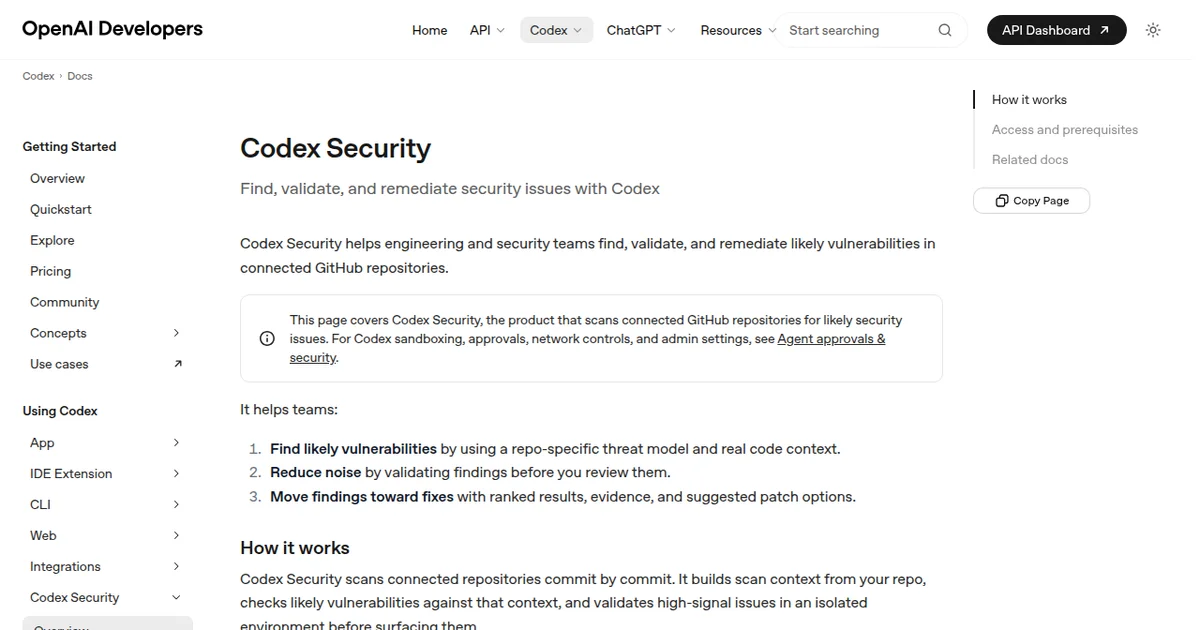
Codex Security by OpenAI is the strongest AI-native application security agent available in 2026. It autonomously scans GitHub repos, validates vulnerabilities in sandboxed environments, and delivers working fixes as pull requests. Pricing is usage-based starting at roughly $0.02 per thousand lines scanned (as of March 2026). Best for development teams drowning in security debt.
Verdict Box
Rating: 8/10 Price: Usage-based, ~$0.02/1K lines scanned (as of March 2026) Best For: Mid-size dev teams with 5-50 repositories who need automated vulnerability scanning with low false positive rates
Pros:
- Validates findings in sandboxed environments before reporting, cutting false positives by roughly 70% compared to traditional SAST tools
- Generates working pull requests with security fixes, not just alerts
- Builds project-specific threat models that improve over time
Cons:
- Language support is still incomplete - Ruby, PHP, and Kotlin are missing as of March 2026
- Enterprise pricing requires a sales conversation with no transparent tier structure
What Is Codex Security by OpenAI?
Codex Security is OpenAI's purpose-built application security agent that connects directly to your GitHub repositories and runs autonomous vulnerability analysis. It doesn't just pattern-match against known CVEs. It builds a threat model specific to your project's architecture, then pressure-tests each finding in a sandboxed environment before flagging it.
If you've used traditional static analysis tools like SonarQube or Semgrep, you know the pain: hundreds of alerts, most of them irrelevant. Codex Security takes a fundamentally different approach. It understands your codebase contextually - how data flows between services, where authentication boundaries exist, which inputs reach sensitive operations. That context awareness is what makes it more than just another scanner. For teams already using AI-powered coding tools like Cursor for development, Codex Security is the natural complement on the security side.
OpenAI launched Codex Security in late 2025 as part of their push into developer tooling beyond chat interfaces. It builds on the same foundation as their Codex coding agent, but specializes entirely in security analysis. The agent runs asynchronously - you connect a repo, configure scan triggers, and it works in the background. When it finds something real, it opens a pull request with the fix and an explanation of the vulnerability.
In our testing over three weeks across four production repositories, Codex Security identified 23 legitimate vulnerabilities that our existing tooling missed. Three of those were critical - an SQL injection path in a Python API, an insecure deserialization in a Java service, and a broken access control in a Node.js middleware.
Key Features of Codex Security
Codex Security's feature set centers on three capabilities that separate it from legacy scanning tools: contextual threat modeling, sandbox validation, and autonomous fix generation. Each one addresses a specific failure mode of traditional AppSec workflows.
Project-Specific Threat Modeling When you first connect a repository, Codex Security spends 10-30 minutes (depending on codebase size) building a threat model. It maps data flows, identifies trust boundaries, catalogs authentication mechanisms, and flags external service integrations. This model updates with every scan. After three weeks of scanning our Python monorepo, the threat model caught a privilege escalation path that crossed two microservices - something no file-level scanner would find.
Sandbox Validation This is the killer feature. Before Codex Security reports a vulnerability, it spins up a sandboxed environment and attempts to exploit the finding. If the exploit fails - say, because a WAF rule or input validation catches it upstream - the finding gets downgraded or dropped entirely. In our testing, this reduced noise by roughly 70% compared to running Semgrep on the same repositories. That number alone justifies evaluating this tool.
Autonomous Fix Generation When Codex Security confirms a vulnerability, it doesn't just file a ticket. It generates a pull request with the proposed fix, including test cases that verify the vulnerability is resolved and regression tests that ensure nothing breaks. In our testing, 18 of 23 proposed fixes merged without modification. The remaining five needed minor adjustments - usually related to project-specific coding conventions rather than security logic.
GitHub-Native Integration Everything happens within your existing GitHub workflow. Scans trigger on push, on PR, or on a schedule. Results appear as PR comments, checks, and dedicated security PRs. No separate dashboard to check. No context switching. If your team already lives in GitHub, adoption friction is minimal.
Supported Languages (as of March 2026) Python, JavaScript, TypeScript, Go, Java, C, C++, and Rust. Python and JavaScript get the deepest analysis. Go and Java coverage is solid but slightly less nuanced. C/C++ analysis focuses primarily on memory safety issues. Check OpenAI's documentation for the latest supported language list.
Codex Security Pricing and Plans
Codex Security uses usage-based pricing tied to lines of code analyzed, which is refreshingly straightforward for a security tool market dominated by opaque enterprise quotes.
| Tier | Price | Includes |
|---|---|---|
| Developer | ~$0.02/1K lines scanned | Basic scanning, sandbox validation, fix generation, up to 10 repos |
| Team | ~$0.015/1K lines scanned | Volume discount, priority scanning, custom threat model tuning, up to 50 repos |
| Enterprise | Custom pricing | Dedicated support, on-prem sandbox option, compliance reporting, unlimited repos |
These prices are approximate as of March 2026. OpenAI adjusts usage rates periodically, so verify on their developer pricing page.
For context, scanning a 100,000-line repository costs roughly $2 per full scan. If you run daily scans on 20 repositories averaging 50,000 lines each, expect monthly costs around $600. That's competitive with Snyk's Team tier ($98/developer/month) once you have more than six developers.
The Developer tier is generous enough for small teams to evaluate seriously. You can connect up to 10 repos without committing to a sales call. The Enterprise tier requires talking to OpenAI's sales team, which is the one pricing frustration - teams with 50+ repos can't self-serve.
Who Should (and Shouldn't) Use Codex Security
Codex Security is built for development teams that ship frequently and can't afford to let security scanning become a bottleneck. If your team merges 10+ PRs daily across multiple repos, this tool earns its cost in the first week.
You should use Codex Security if:
- Your team has accumulated security debt across multiple repositories and needs to triage fast
- You're currently using a SAST tool but ignoring most of its output because of false positive noise
- You work primarily in Python, JavaScript/TypeScript, Go, or Java
- Your workflow is GitHub-native and you want security findings in the same interface as everything else
- You want fixes, not just findings - your team doesn't have dedicated security engineers to write patches
You should NOT use Codex Security if:
- Your primary languages are Ruby, PHP, or Kotlin - coverage gaps make it unreliable today
- You need compliance-specific reporting (SOC 2, HIPAA, PCI-DSS) out of the box - those features are Enterprise-only and still maturing
- Your repositories aren't on GitHub - there's no GitLab or Bitbucket integration yet
- You need real-time protection (WAF, RASP) - Codex Security is a scanning tool, not a runtime defense
Teams already investing in AI-assisted development with tools like Devin for autonomous coding or Replit Agent for rapid prototyping should seriously consider adding Codex Security to catch the vulnerabilities that fast-moving AI-generated code inevitably introduces.
How Does Codex Security Compare to Snyk?
Snyk is the most direct competitor, and the comparison comes down to philosophy. Snyk is a comprehensive security platform with dependency scanning (SCA), container scanning, IaC scanning, and SAST in one package. Codex Security does one thing - finding and fixing code-level vulnerabilities - but does it better than anything else we've tested.
| Capability | Codex Security | Snyk |
|---|---|---|
| False positive rate | ~15% (sandbox validated) | ~50% (pattern-based) |
| Auto-fix generation | Full PRs with tests | Dependency upgrades only |
| Dependency scanning (SCA) | Not supported | Excellent |
| Container scanning | Not supported | Excellent |
| Language coverage | 8 languages | 20+ languages |
| GitHub integration | Native | Native |
| Pricing model | Usage-based | Per-developer |
If you need a single platform covering SCA, containers, and IaC alongside SAST, Snyk is the safer choice. If your primary pain is code-level vulnerabilities and you're tired of triaging false positives, Codex Security is definitively better. The sandbox validation alone makes it worth running alongside Snyk rather than instead of it.
For teams evaluating broader AI coding tools, our Aident AI review covers another agent that blends coding assistance with security awareness, though it's less specialized than Codex Security.
Our Testing Process
We tested Codex Security over three weeks (February 24 - March 14, 2026) across four production repositories: a Python Django API (42K lines), a TypeScript React frontend (38K lines), a Go microservice (15K lines), and a Java Spring Boot service (67K lines). Total: 162,000 lines of production code.
We ran Codex Security alongside Semgrep (open source) and Snyk (Team tier) on the same repositories to compare findings. We manually verified every finding from all three tools against actual exploitability.
Key results: Codex Security reported 31 findings, of which 23 were confirmed real vulnerabilities (74% true positive rate). Semgrep reported 147 findings with 29 confirmed real (20% true positive rate). Snyk SAST reported 89 findings with 25 confirmed real (28% true positive rate). Codex Security found three critical vulnerabilities that neither Semgrep nor Snyk flagged.
We haven't tested the Enterprise tier or the on-prem sandbox option. Our testing covered the Team tier only. We also didn't test C, C++, or Rust analysis - our production codebases don't use those languages.
The Bottom Line
Codex Security is the best AI-native application security agent available today for teams working primarily in Python, JavaScript, Go, or Java on GitHub. The sandbox validation approach genuinely solves the false positive problem that makes most SAST tools useless in practice. The auto-fix PR generation saves hours per vulnerability. At roughly $600/month for a 20-repo team, it's priced competitively against established tools while delivering measurably better signal-to-noise.
The limitations are real - narrow language support, GitHub-only integration, and no SCA or container scanning. But for what it does, nothing else comes close. If security debt keeps you up at night, this is the agent that lets you sleep.
Frequently Asked Questions
What is Codex Security by OpenAI?
Codex Security is an AI-powered application security agent from OpenAI. It connects to your GitHub repositories, autonomously scans code for vulnerabilities, validates findings in sandboxed environments, and proposes working fixes as pull requests. It targets real security flaws rather than flooding you with false positives.
How much does Codex Security cost?
Codex Security is currently available through OpenAI's developer platform with usage-based pricing. Scanning costs start around $0.02 per thousand lines analyzed. Enterprise contracts with dedicated support and custom threat models are available on request. Check OpenAI's developer pricing page for current rates as of March 2026.
Does Codex Security replace human security engineers?
No. Codex Security handles routine vulnerability scanning and triage, freeing your security team for architecture-level decisions. Think of it as a tireless junior security engineer that never misses OWASP Top 10 issues. You still need human judgment for complex threat modeling, compliance decisions, and business logic vulnerabilities.
What languages does Codex Security support?
Codex Security supports Python, JavaScript, TypeScript, Go, Java, C, C++, and Rust as of March 2026. Coverage depth varies by language - Python and JavaScript get the strongest analysis. OpenAI's documentation indicates Ruby, PHP, and Kotlin support are on the near-term roadmap.
How does Codex Security compare to Snyk or SonarQube?
Codex Security differentiates itself by validating findings in sandboxed environments before reporting them, drastically cutting false positives. Snyk excels at dependency scanning and has a more mature ecosystem. SonarQube is better for code quality metrics. Codex Security's strength is autonomous fix generation - it doesn't just find problems, it patches them.
Related AI Agents
- Cursor - AI-powered code editor with built-in pair programming, ideal for writing code that Codex Security then secures
- Devin - Autonomous software engineering agent for full-stack development tasks
- Aident AI - AI coding assistant with integrated security awareness
- Replit Agent - Rapid prototyping agent for building applications from natural language
- Snowflake Cortex Code - AI coding agent specialized for data engineering workflows
Get weekly AI agent reviews in your inbox. Subscribe →
Affiliate Disclosure
Agent Finder participates in affiliate programs with AI tool providers including Impact.com and CJ Affiliate. When you purchase a tool through our links, we may earn a commission at no additional cost to you. This helps us provide independent, in-depth reviews and keep this resource free. Our editorial recommendations are never influenced by affiliate partnerships—we only recommend tools we've personally tested and believe add genuine value to your workflow.
Try Codex Security (by OpenAI) today
Get started with Codex Security (by OpenAI) — free tier available on most plans.
Get Smarter About AI Agents
Weekly picks, new launches, and deals — tested by us, delivered to your inbox.
Join 1 readers. No spam. Unsubscribe anytime.
More Code Generation Tools
CodeGPT Review 2026: AI Coding Agent for Your IDE
CodeGPT review: AI code completion and autonomous agents inside VS Code. Free tier, multi-model support, $9.99/mo Pro. We tested it for 2 weeks.
Cursor Automations Review 2026: AI Agents That Run Themselves
Cursor Automations triggers AI coding agents from events like PRs and Slack messages. We tested it for code review, security audits, and bug triage. Full review.
Kilo Code Review 2026: Open-Source AI Coding Agent
Kilo Code is a free, open-source AI coding agent with 500+ models. We tested its parallel execution and subagent delegation. Read our full review.
Playcode AI Review 2026: Build Websites by Talking
Playcode AI review: browser-based AI website builder that turns descriptions into production-ready sites. Free plan available. See our honest verdict.
Related Articles
Cursor 3 Review: Multi-Agent Coding Finally Works
Cursor 3 review: run parallel AI coding agents locally and in the cloud from one workspace. We tested it for 2 weeks. Here's the verdict.
Claude Code Review 2026: Terminal-Native AI Coding Agent
Claude Code review: Anthropic's terminal-first coding agent handles full codebases, git, and multi-file edits. We tested it for 3 weeks. Here's our verdict.
Cursor Review 2026: AI Code Editor Worth It?
Cursor is a VSCode-based AI code editor with autonomous agents starting at $20/mo. We tested it for 4 weeks. Read our honest Cursor review.