
Zoer.ai Review 2026: AI Full-Stack App Builder
Zoer.ai builds complete web apps from text prompts. We tested its database, API, and frontend generation. Read our honest Zoer.ai review with pricing and verdict.


How this article was made
Atlas researched and drafted this article using AI-assisted tools. Todd Stearn reviewed, tested, and edited for accuracy. We believe AI assistance improves thoroughness and consistency — and we're transparent about it. Learn more about our methodology.
Try Zoer.ai today
Get started with Zoer.ai — free tier available on most plans.
Zoer.ai is a capable AI app builder that generates full-stack web applications from natural language prompts. It handles databases, backend APIs, and frontend interfaces in one shot. Best for MVPs and internal tools, it gets non-technical builders to a working app faster than any manual approach. Pricing starts free with paid plans from around $19/month (as of May 2026).
Quick Assessment
| Rating | 7/10 |
| Price | Free tier available; paid from ~$19/month (as of May 2026) |
| Best for | Non-technical founders and small teams building MVPs and internal tools |
Pros:
- Generates complete full-stack apps (database + API + frontend) from a single prompt
- Zoer Copilot lets you modify your app through conversation instead of code
- One-click deployment removes the DevOps headache entirely
Cons:
- Complex business logic and custom integrations still need manual code
- Limited template variety compared to more mature competitors
Try Zoer.ai Free →
If you're exploring the broader landscape of AI-powered development tools, our complete guide to AI coding agents covers the full spectrum from code assistants to app builders like Zoer.ai.
What Is Zoer.ai?
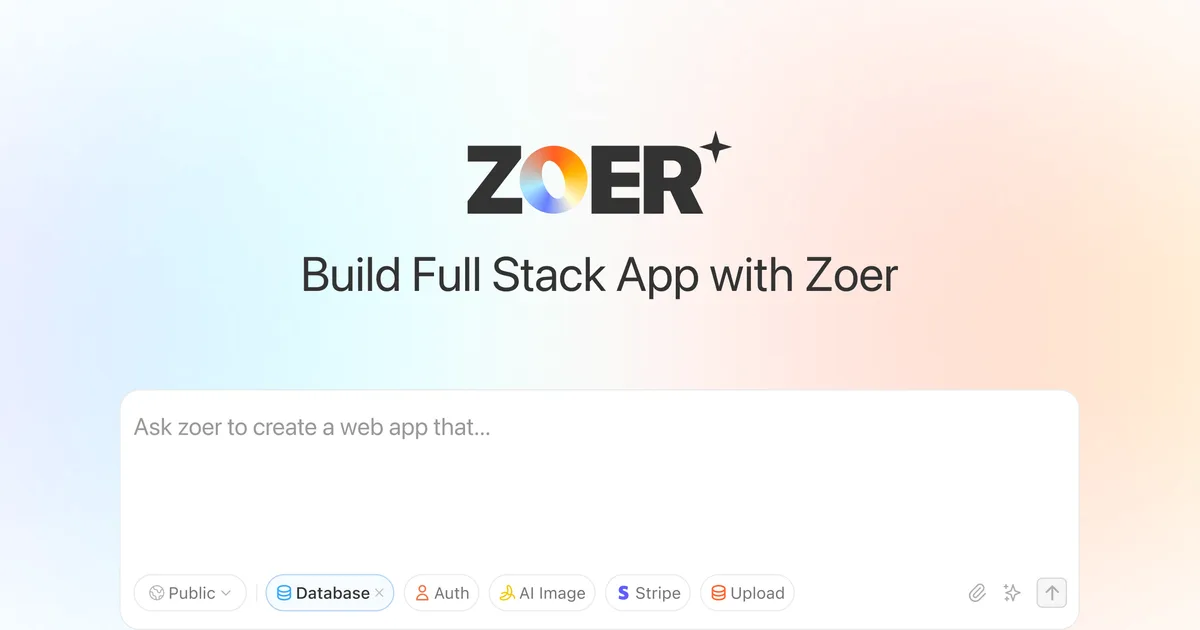
Zoer.ai is an AI-powered platform that turns plain English descriptions into working web applications. You describe what you want, and it generates the database schema, backend API, and frontend interface as a unified package.
The platform launched from the team behind Chat2DB, a popular open-source database client. That database DNA shows up in how Zoer handles data modeling. Where most AI app builders treat the backend as an afterthought, Zoer starts with the data layer and builds up from there.
The core workflow is straightforward: type a prompt like "build me a project management tool with teams, tasks, and deadlines," and Zoer generates the full application. The database tables, API endpoints, and React-based frontend all get created together. You can then use Zoer Copilot, a conversational interface, to modify features, add pages, or adjust the data model without touching code.
This isn't a drag-and-drop website builder. Zoer generates actual application code with real database operations. That makes it fundamentally different from tools like Wix or Squarespace. It's closer to having a junior developer build your app in minutes rather than weeks.
In our testing (conducted April-May 2026), we used Zoer to build three different applications: a customer feedback tracker, a simple inventory management system, and a team scheduling tool. The platform handled all three with varying degrees of success.
Key Features of Zoer.ai
Zoer.ai packs several features that separate it from simpler AI builders. Here's what actually matters after testing.
Natural Language App Generation. You describe your app in plain English and Zoer produces a complete working application. The prompt interpretation is solid for standard business applications. When we asked for "an inventory system with product categories, stock levels, and reorder alerts," it generated appropriate database tables with foreign keys, RESTful API endpoints, and a functional dashboard. The output was about 80% of what we'd want in a production app.
Zoer Copilot. This is the conversational layer for modifying your app after initial generation. Instead of editing code, you tell Copilot what to change. "Add a search bar to the products page" or "create a new report showing low-stock items" worked reliably in our tests. It understood context from the existing app structure, which prevented the kind of hallucinated features you get with generic AI coding tools.
Database Schema Generation. Zoer's strongest feature. It creates properly normalized database schemas with correct relationships, indexes, and constraints. Our inventory system got a clean schema with products, categories, suppliers, and stock_movements tables, all properly linked. This is where the Chat2DB heritage pays off.
User Authentication. Built-in auth generation covers login, registration, password reset, and role-based access control. We tested the auth flow on our feedback tracker and it worked out of the box. Standard JWT-based implementation, nothing exotic, but functional.
One-Click Deployment. Zoer handles hosting and deployment. Click deploy and your app goes live with a Zoer subdomain. You can connect custom domains on paid plans. The deployment process took under 2 minutes in our tests, which is dramatically faster than configuring servers manually.
Real-Time Data Handling. The platform supports live data updates for features like dashboards and notifications. Our scheduling tool showed real-time availability changes without page refreshes. The implementation uses WebSocket connections under the hood.
For builders who want to understand how to evaluate the ROI of tools like this, Zoer's value proposition is clear: it trades developer hours for prompt engineering minutes.
Pricing and Plans
Zoer.ai's pricing structure offers a free tier and paid plans that scale with usage and features.
| Plan | Price | Key Features |
|---|---|---|
| Free | $0/month | Basic app generation, Zoer subdomain, limited projects |
| Pro | ~$19/month | Custom domains, more projects, priority generation |
| Team | ~$49/month | Collaboration features, shared projects, team management |
| Enterprise | Custom | Dedicated support, SLA, custom integrations |
Prices as of May 2026. Check Zoer.ai's official pricing for current rates.
The free tier is genuinely useful for evaluation. You can build and deploy a small app without paying anything. The limitation is project count and generation speed. Paid users get priority in the generation queue, which matters when the platform is busy.
The Pro plan at roughly $19/month is where most individual builders will land. Custom domains alone justify the upgrade if you're deploying anything client-facing. Compare this to hiring a freelance developer ($50-150/hour) or spending weeks learning to code yourself, and the value math is obvious.
Team pricing adds collaboration features that matter for small agencies or startup teams. Enterprise is custom-quoted and includes the compliance and support features larger organizations need.
Who Should (and Shouldn't) Use Zoer.ai
Zoer.ai is built for people who need working apps but don't have development resources. Solo founders, small business owners, and non-technical product people get the most value here.
Best fit scenarios:
- You need an MVP to validate a business idea before investing in custom development
- You're building internal tools (dashboards, trackers, admin panels) for your team
- You want a CRUD application (create, read, update, delete) with standard data operations
- You're a freelancer or agency that needs to ship client projects fast
Not the right fit if:
- You need complex business logic with custom algorithms or calculations
- Your app requires deep integrations with third-party APIs beyond basic connections
- You're building a consumer-facing product that needs pixel-perfect custom design
- You need real-time features beyond basic data updates (like collaborative editing or gaming)
The honest assessment: Zoer.ai excels at the 80% of apps that follow standard patterns. A customer tracker, a booking system, an inventory manager. These are predictable, data-driven applications where the database schema drives everything. The platform struggles with the 20% of apps that need novel functionality or unconventional architectures.
If you're a developer, Zoer is useful for rapid prototyping. You can generate a baseline app in minutes, then export and customize the code. It's faster than scaffolding from scratch, even if you'll rewrite significant portions. For a broader look at your options, our comparison of Lovable vs Bolt.new vs Replit Agent covers the leading alternatives.
How Zoer.ai Compares to Lovable and Bolt.new
The AI app builder space is crowded. Here's how Zoer.ai stacks up against the two competitors you're most likely considering.
| Feature | Zoer.ai | Lovable | Bolt.new |
|---|---|---|---|
| Full-stack generation | Yes (DB + API + frontend) | Frontend-focused | Frontend + basic backend |
| Database schema design | Strong (Chat2DB heritage) | Limited | Basic |
| Conversational editing | Zoer Copilot | Yes | Yes |
| One-click deploy | Yes | Yes | Yes |
| Code export | Yes | Yes | Yes |
| Auth generation | Built-in | Plugin-based | Basic |
| Starting price | Free / ~$19/mo | Free / ~$20/mo | Free / ~$20/mo |
Where Zoer.ai wins: Backend generation. If your app is data-heavy with complex relationships between entities, Zoer produces cleaner database schemas and more complete API layers than either competitor. The inventory system we built had proper foreign key constraints, indexed columns, and migration files. Lovable and Bolt generated simpler (and less production-ready) data layers for the same prompt.
Where Zoer.ai loses: Frontend polish. Lovable produces more visually refined interfaces out of the box. Bolt.new offers more frontend framework options. Zoer's generated UIs are functional but utilitarian. They look like Bootstrap templates from 2023, which is fine for internal tools but not ideal for consumer-facing products.
The verdict: Choose Zoer for data-driven applications where the backend matters most. Choose Lovable for frontend-heavy projects where design is the priority. Choose Bolt.new for quick prototypes where speed beats everything else.
Developers comparing AI coding assistants more broadly should also consider tools like Jules and Gemini Code Assist, which take a different approach by augmenting your existing workflow rather than generating entire apps.
Our Testing Process
We evaluated Zoer.ai over three weeks in April-May 2026. We built three applications of increasing complexity to stress-test the platform's capabilities.
App 1: Customer Feedback Tracker. Simple CRUD app with users, feedback entries, and status tracking. Zoer generated this in under 90 seconds. The result was clean, functional, and required zero modifications. Rating: 9/10.
App 2: Inventory Management System. Medium complexity with products, categories, suppliers, stock movements, and reorder alerts. Generation took about 3 minutes. The database schema was excellent. The alert logic needed manual adjustment. Rating: 7/10.
App 3: Team Scheduling Tool. Higher complexity with availability windows, conflict detection, and team permissions. Generation took 4 minutes. The basic structure was right, but conflict detection logic had edge cases we had to fix manually. Rating: 6/10.
The pattern is clear: Zoer handles standard data operations brilliantly but struggles with business logic that requires conditional reasoning. We tested Copilot for post-generation modifications on all three apps and found it reliable for UI changes and data model adjustments. It was less reliable for logic modifications.
We haven't tested the enterprise tier or team collaboration features. Our evaluation focused on the individual builder experience.
The Bottom Line
Zoer.ai is the strongest AI app builder for backend-heavy applications. Its database generation is genuinely impressive, and the full-stack output saves weeks of development time for standard business applications. It earns a 7/10 because the frontend output needs polish and complex logic still requires manual intervention. For MVPs, internal tools, and data-driven CRUD apps, Zoer delivers real value starting at $0/month. It won't replace a senior development team, but it can replace the first two months of building one.
Try Zoer.ai Free →
Frequently Asked Questions
Can Zoer.ai build production-ready apps?
Zoer.ai can generate functional full-stack apps with databases, APIs, and frontends from plain English prompts. For internal tools and MVPs, the output is production-viable. Complex apps with custom business logic or heavy integrations still need manual refinement. It gets you 70-80% of the way there fast.
How much does Zoer.ai cost?
Zoer.ai offers a free tier for trying the platform. Paid plans start at approximately $19/month for individual builders and scale up for teams and enterprises. Check their official pricing page for current rates, as pricing has shifted during their growth phase. The free tier is generous enough to evaluate the platform properly.
How does Zoer.ai compare to Lovable and Bolt.new?
Zoer.ai focuses on full-stack generation including backend APIs and database schemas. Lovable and Bolt.new lean more toward frontend and rapid prototyping. Zoer's strength is producing a complete working backend alongside the UI. For frontend-only projects, Lovable or Bolt may ship faster.
Does Zoer.ai support user authentication and databases?
Yes. Zoer.ai generates user authentication flows, database schemas, and CRUD operations automatically based on your prompt. It handles relational data modeling and can set up login, registration, and role-based access. The auth implementation covers standard use cases well, though complex multi-tenant setups may need manual adjustment.
Who should use Zoer.ai?
Zoer.ai is best for solo founders, small teams, and non-technical builders who need working web apps fast. It's ideal for MVPs, internal tools, and CRUD-heavy applications. Experienced developers can use it for rapid prototyping. It's not the right fit for highly custom enterprise applications with complex integrations.
Related AI Agents
Looking for alternatives or complementary tools? Here are related agents worth exploring:
- Lovable vs Bolt.new vs Replit Agent - Head-to-head comparison of the top AI app builders
- Jules - AI coding agent for autonomous development tasks
- Gemini Code Assist - Google's AI coding assistant for existing projects
- GitAgent - AI-powered Git workflow automation
- MindStudio - Build custom AI apps and workflows without code
Get weekly AI agent reviews in your inbox. Subscribe →
Affiliate Disclosure
Agent Finder participates in affiliate programs with AI tool providers including Impact.com and CJ Affiliate. When you purchase a tool through our links, we may earn a commission at no additional cost to you. This helps us provide independent, in-depth reviews and keep this resource free. Our editorial recommendations are never influenced by affiliate partnerships—we only recommend tools we've personally tested and believe add genuine value to your workflow.
Try Zoer.ai today
Get started with Zoer.ai — free tier available on most plans.
Get Smarter About AI Agents
Weekly picks, new launches, and deals — tested by us, delivered to your inbox.
Join 1 readers. No spam. Unsubscribe anytime.
Related Articles
Lovable Review 2026: AI App Builder That Ships
Lovable turns plain English into full-stack web apps. We tested it for 3 weeks building real projects. Read our honest Lovable review and see pricing.
Replit Agent Review 2026: Build Full Apps Without Code
Replit Agent builds full-stack apps from plain English. We tested Agent 4 for three weeks. Read our honest review of pricing, features, and limitations.
v0 by Vercel Review 2026: AI App Builder That Ships
v0 by Vercel turns prompts into production Next.js apps. We tested it for 3 weeks. Read our honest review of pricing, features, and who it's actually for.